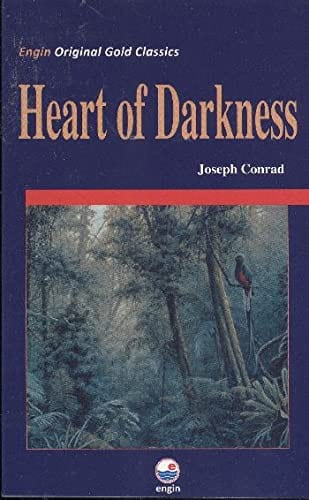
Heart of Darkness is back in the spotlight this week, with Variety reporting that filmmaker Midi Z draws on the novella for his project The Exiles. More than a century after its 1902 publication, Joseph Conrad’s tale of a river journey into the Congo is still shaping how artists talk about power, empire, and the shadows people carry.
For listeners on Spinn Radio, that makes this a perfect moment to experience Conrad’s story as it first hit audiences: as a voice telling a tale, full of doubt and second-guessing. In audio form, the unreliable narrator, the oppressive colonisation of Africa, and the slow approach to Kurtz all feel less like distant literature and more like someone confessing in your ear.
Key facts
- Author
- Joseph Conrad
- Genre
- Nautical & Marine Fiction
- Published
- 1902
- Language
- English
- Chapters
- 6
The core story of Heart of Darkness in plain language
Heart of Darkness follows Marlow, a ship’s captain hired by “the Company” to travel deep into the African interior and bring back a rogue agent named Kurtz. Europe still maps much of Africa as a vague shadow, a blank space to be filled by commercial ambition. The Company sends Marlow upriver to fix a problem in the trading network. Instead he discovers what happens when that blank space becomes a stage for cruelty and obsession.
The premise is simple enough: a river voyage, a mysterious man at the end of it, and a mission that is supposed to restore order. What gives the story its grip is the way each new station and encounter strips away the polite language of “civilising” and “trade.” The closer Marlow gets to Kurtz, the more he sees how thin the rituals of civilisation really are, and how quickly they give way to barbarism when profit and power are on the line.
Conrad based this on his own terrible experience in the Congo, so the details bite. The Company is not an abstract villain. It is a set of routines, paperwork, and euphemisms that let supposedly respectable men excuse brutality. As you listen, that contrast becomes the main tension: not action scenes on the river, but the constant clash between what Marlow wants to believe and what he actually sees.
“The closer Marlow gets to Kurtz, the more every polite phrase about “civilisation” begins to sound like a lie.”
Joseph Conrad, 1902 and the age of oppressive colonisation
Heart of Darkness appeared in 1902, in the high tide of European colonisation. Vast areas of the globe sit under foreign rule, and Africa in particular is carved up on maps by people who have never seen its rivers or forests. Conrad writes in English, but he writes against the complacent English-speaking world that treats this expansion as a moral mission instead of a commercial land grab.
Knowing the era matters. When Marlow sails for the Congo under the Company’s flag, he is stepping into a system that most of his contemporaries regard as normal, even noble. Listening now, you hear how deliberately Conrad punctures that self-image. The novella treats “civilisation” as a performance, a set of rituals that can be packed up and carried into the jungle, but not necessarily believed once the masks slip.
That historical setting also explains why the book has fed so many later works, from critical essays to adaptations like the film Apocalypse Now. Artists keep returning to this 1902 story because it captures a crucial moment when Europe’s confidence in its own righteousness begins to crack, yet refuses to look fully in the mirror. On audio, those cracks sound like hesitations in Marlow’s voice, or like the weight he puts on a word such as “horror” or “darkness.”
“Conrad is writing from inside the age of empire, not looking back on it, which is why the story’s self-doubt feels so raw.”
Spinn Radio
Listen to Heart of Darkness on Spinn Radio
Why Heart of Darkness still feels so modern
Heart of Darkness endures because it is less interested in exotic scenery than in how people invent stories to excuse what they do. The line between civilisation and barbarism is the recurring theme, and Conrad insists that this line is “frighteningly fine.” In the Congo, it takes very little for Company men to move from tidy offices and refined manners to forced labour and terror, all while they keep using the same respectable vocabulary.
That focus on self-deception keeps the book relevant to any era that wants to call its projects “progress.” The Company’s memos, targets, and supply chains would not feel out of place in a modern corporation. The way Marlow talks himself into and out of complicity feels uncomfortably familiar. He witnesses atrocities, but he also keeps working, rationalising that his role is limited and his hands comparatively clean.
The story’s influence also travels across media. The dossier summary notes Apocalypse Now as the best known adaptation. Relocating the plot to a different century and conflict did not require changing the core structure: a mission upriver, a charismatic figure gone off the rails, a narrator forced to face his own capacity for darkness. When a director like Midi Z cites Heart of Darkness while talking about a new film, it confirms that Conrad’s basic pattern of journey, confrontation, and moral shock still works as a template for exploring war, exile, or exploitation today.
“Conrad’s most unsettling idea is that the real journey is not into the jungle but into the fictions people tell to live with themselves.”
Listening to Heart of Darkness as nautical & marine fiction
On paper, Heart of Darkness sits in Nautical & Marine Fiction, and that label matters when you hear it aloud. Much of the book unfolds on water: a ship in Europe that frames the storytelling, and the steamer Marlow pilots up the Congo. The rhythms of the river, the stops at various stations, and the constant attention to navigation give the narrative its pulse. In audio, those details become less technical and more hypnotic, like listening to a logbook that slowly turns into a confession.
The story is compact, at just 6 chapters in English. That makes it ideal for listening in a few concentrated sessions rather than spreading it thin over weeks. The short form intensifies the mood. You hear Marlow repeating certain phrases or circling back to the same images, and those echoes accumulate quickly when you are listening rather than reading in fragments. It feels like being trapped in one long, sleepless night on deck, with only this narrative for company.
As nautical fiction, it also offers a different kind of sea story than heroic exploration. The voyage up the Congo is not about discovery in a celebratory sense. It is about discovering how much can go wrong when people treat a river and the people who live along it as raw material. For listeners who enjoy maritime settings but are tired of straightforward adventure tales, this mix of rivercraft detail and psychological unease is a sharp alternative.
“Heart of Darkness plays like a logbook that has slipped into nightmare, every nautical detail pulling you further from safe harbour.”
How to get the best experience from the audiobook
Because Heart of Darkness is told through a classic unreliable narrator, the listening experience depends on staying attuned to Marlow’s shifts in tone. This is a character who is always revising his own story, interrupting himself, and weighing his words. On audio, that means you can almost hear the moments when he flinches from a memory or smooths over his own involvement. Giving the book your full attention, rather than treating it as background noise, lets you catch those small hesitations.
The English language of 1902 can feel dense on the page, but hearing it spoken helps the sentences breathe. Patterns of repetition and rhythm that might look heavy in print come across as deliberate oral storytelling, the way someone might keep circling back to the same phrase when trying to describe something they do not fully understand. The result is a closer connection to the text’s uncertainty and discomfort.
With only 6 chapters, you can choose to listen all at once for a single, immersive descent into Conrad’s Congo, or break the journey into two or three stretches that match Marlow’s progress upriver. Either way, the audiobook highlights what has kept the novella alive for more than a century: not the shock value of its setting, but the slow, uneasy feeling that the darkness Marlow finds in Kurtz’s soul is inseparable from his own.
“On audio, Marlow’s hesitations and self-corrections become as important as the events he describes.”
Good to know
Frequently asked questions
Who wrote Heart of Darkness?
Heart of Darkness was written by Joseph Conrad. He drew closely on his own terrible experience in the Congo to shape Marlow’s journey and the character of Kurtz.
When was Heart of Darkness published?
Heart of Darkness was published in 1902. It appeared during a peak period of European colonisation, which shapes its focus on empire and exploitation.
What genre is Heart of Darkness?
Heart of Darkness is classified as Nautical & Marine Fiction. Much of the narrative takes place on ships and along the Congo River, with maritime detail driving the story’s mood.
How many chapters are in Heart of Darkness?
Heart of Darkness has 6 chapters. The compact structure makes it well suited to an intense, focused audiobook listening experience.
What language is Heart of Darkness in?
Heart of Darkness is written in English. Joseph Conrad uses the language of his adopted country to question the assumptions of its imperial age.