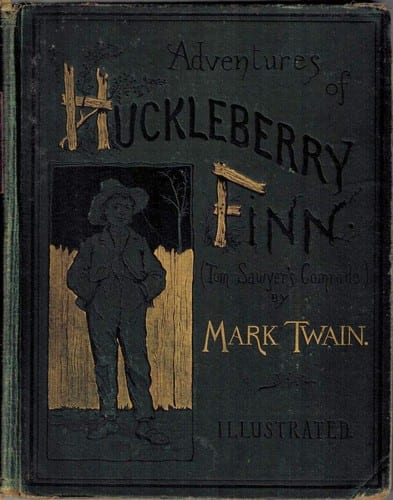
Adventures of Huckleberry Finn lands differently in a week when The Economic Times is quoting Mark Twain on happiness as “a contrast with something that ain’t pleasant.” Twain wrote about that contrast long before the soundbite era, and nowhere more clearly than in Huck’s uneasy mix of freedom, fear and moral doubt on a raft in the dark.
First published in 1884 as children’s fiction, this 43‑chapter river novel becomes something sharper in audio. Heard aloud, Huck’s plainspoken voice, his scrap with conscience over helping Jim, and the novel’s shifting moods feel less like a school assignment and more like a late-night confession floating down the Mississippi.
Key facts
- Author
- Mark Twain
- Genre
- Children's Fiction
- Published
- 1884
- Language
- English
- Chapters
- 43
What is the story in Adventures of Huckleberry Finn?
At its simplest, Adventures of Huckleberry Finn is the story of a boy and a man on the run. Huck, first introduced as Tom Sawyer’s scruffy sidekick, bolts from his drunk and abusive father. Jim, an enslaved man, runs because he is about to be sold. They end up together on a rough raft, drifting down the Mississippi River and trying to keep ahead of danger on the shore.
Along the river they collide with con men, feuding families and small-town busybodies, the kind of “colorful characters” that make the book a staple for younger readers as much as for adults. But the real movement is inside Huck’s head. He has been taught that helping a runaway slave is a sin. Every mile they float forces him to weigh that lesson against what he actually sees: Jim as a patient, loyal, deeply human friend.
Listening to an audiobook version puts that tug-of-war on a tight wire. When Huck quietly decides to keep helping Jim, even though he believes it might damn him, the choice lands not as an abstract “theme” but as a trembling, spoken decision you hear in a child’s voice.
“The river moves them south, but in audio you feel Huck moving inward, toward a conscience that scares him.”
Mark Twain, 1884 America and the edge of “children’s fiction”
Mark Twain published Adventures of Huckleberry Finn in 1884, technically shelving it as children’s fiction and as a sequel to The Adventures of Tom Sawyer. That label is true in one sense: it follows familiar characters and has pranks, disguises and wild escapes that still hook younger listeners.
Yet the book grew into something far more serious as Twain wrote it. Through Huck’s offhand observations and Jim’s quiet persistence, Twain’s views on slavery and other social issues of the time surface in ways that are hard to miss. The jokes and escapades, especially heard aloud, sit next to scenes that are tense, frightening or morally stark. The result is a story that children can follow for the adventure, while adults hear the bite of Reconstruction-era America just beneath the surface.
Approaching it now in audio lets you feel that dual identity. The same chapter can play like roughhouse comedy to one listener and like a bitter critique of the society on shore to another.
“File it under children’s fiction if you like, but in Twain’s 1884 America this “kids’ book” carried some of his sharpest social writing.”
Spinn Radio
Listen to Adventures of Huckleberry Finn on Spinn Radio
Why Adventures of Huckleberry Finn still provokes and endures
Adventures of Huckleberry Finn has never really gone quiet. The American Library Association listed it as fifth on the most frequently challenged books of the 1990s, which tells you as much about the story’s nerve endings as about the censors. Families, schools and libraries have argued over it for generations, precisely because it presses on race, morality and language in ways that stay uncomfortable.
Part of its endurance lies in how Twain built the book around Huck’s internal struggle. The drama is not only whether they will be caught. It is whether Huck will keep honoring what he has been taught, or what he has come to believe about Jim. That specific conflict, between inherited rules and lived experience, makes the novel feel surprisingly current to new listeners who may know nothing about 19th‑century Missouri.
The controversy also keeps people coming back. Many readers first encounter the book in a classroom. Coming to it later, as an audiobook, can be its own small rediscovery: the same scenes that once felt like homework suddenly sound raw and unresolved, which is part of why the novel still matters.
“This is not a relic that gathers dust. It is a book people still argue about, which is one reason it is worth hearing with fresh ears.”
How Huck’s voice and dialect come alive in the audiobook
One of the most striking things about Adventures of Huckleberry Finn, especially in English, is that it is narrated by Huck himself. Twain writes in the various dialects common to the time and place, and that choice was unusual in 1884. On the page, those spellings and rhythms can look dense. In audio, they suddenly have air and tempo.
You hear Huck’s slang relax into a natural flow. Jim’s speech patterns, often flattened in print, gain warmth and pacing. The regional voices of the people they meet along the river stop feeling like eccentric spellings and become distinct personalities, with different cadences and attitudes. For many listeners, that shift from decoding text to simply hearing voices is the moment the novel starts to feel lived-in rather than “literary.”
A full 43‑chapter run time also changes how you experience the story. The raft sections can feel long on the page. In your headphones, those stretches become a kind of sonic drift, with quiet patches broken by sudden chaos when Huck and Jim pull ashore. It is an ideal book for long, immersive listening sessions, whether you queue up a few chapters at a time or let the river carry you for an afternoon.
“On the page you decode the dialects. In the audiobook you just hear people talking, which is how Twain meant it to feel.”
Tips for first-time listeners to Adventures of Huckleberry Finn
If this is your first time hearing Adventures of Huckleberry Finn, it helps to know what kind of journey you are taking. The book is structured as a long sequence of 43 chapters, many of them self-contained episodes that stack into a larger arc. That makes it easy to listen in chunks without losing the thread, as long as you remember the basic aim: Huck and Jim trying to stay free on the river.
Give yourself space with the opening chapters as the dialect settles in your ear. By the time Huck and Jim are firmly on the raft, most listeners find the voices feel natural. From there, you can lean into the rhythm: quiet, starlit drifting, then bursts of sharp, sometimes absurd encounters on land. Hearing those shifts without the visual break of page turns can make the story feel more like a single, evolving tale than a set of “adventures.”
Above all, listen for the friendship at the center. The plot throws Huck and Jim into danger again and again, but what lingers, especially in audio, is the way their conversations slowly change. If you come away remembering just one thing, let it be Huck’s dawning sense that Jim is not a problem to be solved but a good man whose fate he cannot ignore.
“Treat it less like a school text and more like a river story told aloud over several evenings.”
Good to know
Frequently asked questions
Who wrote Adventures of Huckleberry Finn?
Adventures of Huckleberry Finn was written by Mark Twain. He continued the story of Huck after The Adventures of Tom Sawyer and pushed it into more serious territory.
When was Adventures of Huckleberry Finn published?
Adventures of Huckleberry Finn was published in 1884. Its late 19th‑century setting and attitudes are part of what gives the audiobook its distinctive atmosphere.
What genre is Adventures of Huckleberry Finn?
Adventures of Huckleberry Finn is classified as children’s fiction. Its adventurous surface makes it accessible to younger listeners while its themes resonate with adults.
How many chapters are in Adventures of Huckleberry Finn?
Adventures of Huckleberry Finn contains 43 chapters. That episodic structure makes it easy to enjoy in multiple listening sessions or in one long stretch.
Why is Adventures of Huckleberry Finn considered controversial?
Adventures of Huckleberry Finn is considered controversial and was fifth on the American Library Association’s most frequently challenged books list in the 1990s. Its treatment of slavery, race and language keeps it at the center of debates about what belongs on shelves and syllabi.
Sources