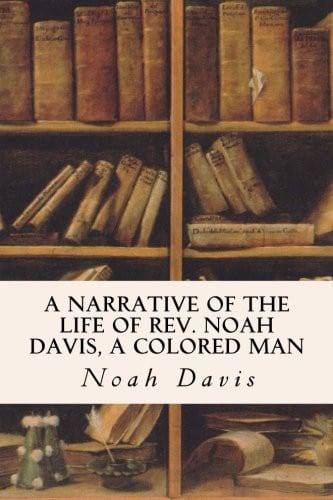
Narrative of the Life of Rev. Noah Davis, A Colored Man is not a quiet historical artifact. It is an 1859 autobiography written with a single burning purpose: to raise enough money to free the last two of Noah Davis’s children from slavery.
Across nine chapters of Biography & Autobiography, Davis tells how he bought himself, his wife, and five of his children at a total cost of more than four thousand dollars, then turns to the reader and asks for help. Heard as an audiobook in 2024, that direct appeal feels startlingly present, a human voice reaching across more than a century and a half, asking you to listen and to care.
Key facts
- Author
- Noah Davis
- Genre
- Biography & Autobiography
- Published
- 1859
- Language
- English
- Chapters
- 9
What “Narrative of the Life of Rev. Noah Davis, A Colored Man” is about
At its core, Narrative of the Life of Rev. Noah Davis, A Colored Man is a self-told life story with a very practical mission. Davis explains upfront that he has prepared this account to raise sufficient means to free his last two children from slavery. He has already purchased freedom for himself, his wife, and five of his children, and he tells you exactly what that cost: more than four thousand dollars over twelve years.
The narrative traces how a man born into slavery becomes a free Black Baptist minister who spends a quarter of a century preaching the gospel among his own people while simultaneously fighting to reunite his family. The book is firmly rooted in lived experience rather than abstract argument. Every chapter is anchored in the economics of bondage and the spiritual resolve that keeps him moving toward freedom for each child.
One key takeaway for first-time listeners: this is not a detached overview of slavery in America. It is one father’s ledger of love and sacrifice, written to convert your attention into money, and that urgency is what gives the story its sting.
“This is one father’s ledger of love and sacrifice, written to convert your attention into money.”
Who Noah Davis was and why 1859 matters for his story
Noah Davis writes as both subject and author. A Black man who had been enslaved, he eventually secured his own freedom, then that of his wife and five children, before turning to the page to fight for the last two still in bondage. The book names him simply and clearly as Noah Davis, and every line is shaped by his dual identity as a father and a Baptist minister.
The year of publication matters. Released in 1859, the narrative lands on the eve of the American Civil War, when the country is already fracturing around the question of slavery. Davis does not write as someone looking back from safety. He speaks from inside an ongoing crisis, with two children still enslaved and no guarantee that the political future will favor them. That immediacy gives the narrative a different texture from later memoirs written in hindsight.
Across its nine chapters, Davis also insists on the role of faith in his survival. He describes how God has blessed him by granting freedom to “so large a portion” of his family and by giving him the hope of the gospel and the calling to preach it. For listeners, this means the book sits at the intersection of Black history, religious testimony, and family chronicle, all framed by the brutal arithmetic of a slave society.
“He does not write as someone looking back from safety, but as a father with two children still enslaved and no guarantee of rescue.”
Spinn Radio
Listen to Narrative of the Life of Rev. Noah Davis, A Colored Man on Spinn Radio
The central themes: freedom, family, faith, and hard economics
Three themes dominate Narrative of the Life of Rev. Noah Davis, A Colored Man: freedom, family, and faith, all bound together by money. Davis is blunt about the financial reality of slavery. He has “purchased himself, his wife, and five of his children, at a cost, altogether, of over four thousand dollars, ” and he repeats that figure as both a badge of perseverance and an accusation against a system that turns spouses and children into assets to be redeemed.
Family is the emotional engine of the book. Every chapter circles back to his children, especially the last two he is still trying to free. The narrative is an extended act of parental care, translated into fundraising. When he asks a “humane and christian public” to aid him in the sale of the book, you feel a father harnessing every skill he has, including storytelling, to keep his family from being permanently torn apart.
Faith runs through the narrative as explanation and fuel. Davis sees his partial success as evidence that God has “blessed him in an extraordinary manner” and given him the hope of the gospel. That does not soften the cruelty he describes. Instead it frames endurance as a spiritual practice, one that many listeners steeped in later Black religious traditions will recognize as foundational. The memorable detail here is that very specific four thousand dollar sum, repeated like a refrain that keeps the human cost from slipping into abstraction.
“He turns every page into a collection plate for his children’s freedom, passing it to each reader in turn.”
Why this 1859 autobiography still feels urgent to listeners
For contemporary audiobook listeners, the most striking thing about Narrative of the Life of Rev. Noah Davis, A Colored Man is how intentionally it speaks to an audience. Davis does not write for posterity. He writes to you. He explains his purpose, counts out the dollars, and urges a “humane and christian public” to help finish the task that has consumed twelve years of his life.
That direct address gives the book a modern edge. It anticipates crowdfunding and mutual aid, but in the context of slavery’s terror. The narrative also holds up as a document of agency. Davis is not a passive subject of history. He is a strategist, a working preacher, and a fundraiser who uses the tools available to him in 1859: a printing press, a pulpit, and his own story.
The enduring power of the book lies in that combination of agency and vulnerability. You hear a man who has already accomplished something extraordinary, yet who must still ask strangers to buy his book so his last two children can stand beside the rest of their family in freedom. That request carries across time, which is part of why the story still resonates when heard aloud.
“Davis does not write for posterity. He writes to you, and he tells you exactly what your attention is meant to do.”
What the audiobook listening experience feels like
As an audiobook, Narrative of the Life of Rev. Noah Davis, A Colored Man leans into the intimacy already built into its pages. The language is 19th century, but the intent is crystal clear: this is a preacher and parent speaking directly, chapter by chapter, across roughly the span of a short modern book. The nine-chapter structure makes it natural to listen in thoughtful segments rather than rushing through.
Hearing the narrative instead of reading it on the page highlights Davis’s role as a minister who has been preaching “about twenty-five years.” His prose carries the cadence of someone used to addressing a congregation, repeating key points for emphasis, layering gratitude for God’s blessings alongside unsparing references to his family’s bondage. In audio form, those rhythms become more pronounced.
For listeners exploring Biography & Autobiography on Spinn Radio, this title sits alongside other first-person accounts but occupies a specific space: an 1859 English-language life story whose stated object is to free two enslaved children. That concrete goal gives the listening experience a built-in tension. By the time the credits roll, you do not just know Noah Davis better. You have heard the exact stakes that drove him to write at all.
“The nine chapters feel like a series of spoken appeals, each one tightening the focus on two children you never meet but never forget.”
Good to know
Frequently asked questions
Who wrote Narrative of the Life of Rev. Noah Davis, A Colored Man?
Narrative of the Life of Rev. Noah Davis, A Colored Man was written by Noah Davis. He tells his own story as a formerly enslaved Baptist minister and father.
When was Narrative of the Life of Rev. Noah Davis, A Colored Man published?
Narrative of the Life of Rev. Noah Davis, A Colored Man was published in 1859. It appears just before the American Civil War, while two of his children are still enslaved.
What genre is Narrative of the Life of Rev. Noah Davis, A Colored Man?
Narrative of the Life of Rev. Noah Davis, A Colored Man is Biography & Autobiography. It is a first-person account focused on family, faith, and the price of freedom.
How many chapters are in Narrative of the Life of Rev. Noah Davis, A Colored Man?
Narrative of the Life of Rev. Noah Davis, A Colored Man has 9 chapters. The structure makes it easy to listen in focused segments as an audiobook.
Why did Noah Davis write Narrative of the Life of Rev. Noah Davis, A Colored Man?
Noah Davis wrote Narrative of the Life of Rev. Noah Davis, A Colored Man to raise money to free his last two children from slavery. He hoped sales would complete a twelve-year effort that had already cost him over four thousand dollars.
Shop the story
Reading Essentials
 Editor's Pick
Kindle Scribe Colorsoft (64 GB)
11-inch color E Ink display + pen
$679.99
View on Amazon
Kindle Scribe (32 GB)
11-inch paper-like display + pen
$499.99
View on Amazon Bestseller
Kindle Paperwhite (16 GB)
The fastest Kindle e-reader
View on Amazon
The Hobbit & The Lord of the Rings Boxed Set
Deluxe pocket boxed set
$24.92
View on AmazonAs an Amazon Associate, Spinn Radio earns from qualifying purchases.
Browse the full Spinn Shop →Sources