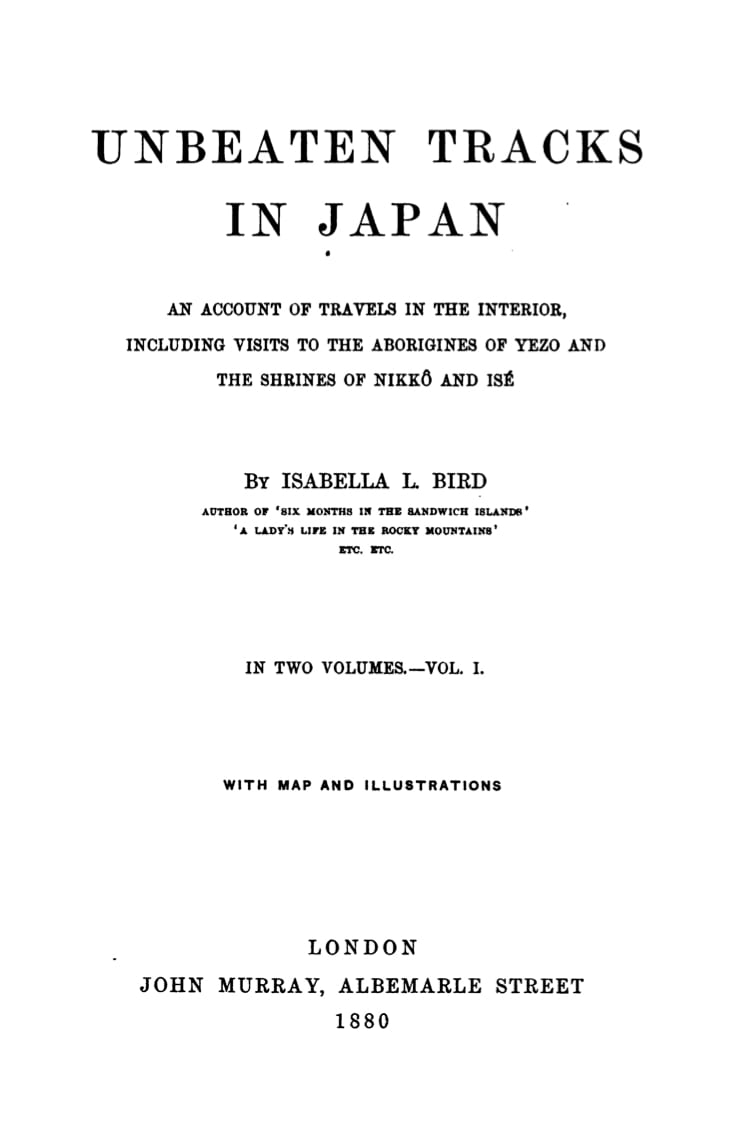
Unbeaten Tracks in Japan begins as a set of private letters home, yet in audio it plays like a long, intimate conversation with a traveller who never meant to tidy up the mess of the road. Isabella L. Bird, a 19th century English traveller and natural historian, rides and walks from Edo to Niigata, on to Aomori and across to Yezo, reporting every texture of the journey to her sister.
What you hear is 1878 Japan in real time: river crossings, mountain passes, inn gossip, and, in the north, Bird’s close observation of the Ainu, an indigenous people whose daily life she records in absorbing, practical detail. Across 58 English-language chapters of non-fiction, the audiobook turns a seven‑month sojourn into a steady, immersive listening ritual.
Key facts
- Author
- Isabella L. Bird
- Genre
- *Non-fiction
- Published
- 1878
- Language
- English
- Chapters
- 58
What is Unbeaten Tracks in Japan actually about?
Unbeaten Tracks in Japan is non-fiction built from letters Isabella L. Bird sent during seven months in Japan in 1878. Rather than a polished travel guide, it is a serial account of movement: she begins in Edo (now Tokyo), threads inland through the interior where villagers may never have seen a foreigner, reaches the coastal city of Niigata, then continues north to Aomori before crossing to Yezo (Hokkaido). Each stop adds another layer of road dust to the narrative.
Because the book preserves the letter form, you follow the journey almost stage by stage. One chapter might linger in a single village inn, the next on a hard stretch of road between Edo and the interior, the next on the sea route toward Aomori. The “unbeaten tracks” of the title are literal: Bird often rides into communities where her presence is a spectacle, and her writing catches the awkwardness and curiosity of those first meetings.
The concrete takeaway: this is a route you can trace in your mind as you listen, from Edo to Niigata to Aomori to Yezo, with each of the 58 chapters a small, self-contained leg of the road.
“Each of the 58 chapters feels like a fresh leg of the road, posted home from somewhere just beyond the last milestone.”
Isabella L. Bird and the late 19th century travel boom
Isabella L. Bird published Unbeaten Tracks in Japan in 1878, right in the middle of the 19th century’s hunger for travel narratives. She had already proved she could turn a journey into a book: her first trip abroad, to America in 1854 to visit relatives, produced The Englishwoman in America, published anonymously two years later. By the time she reached Japan, she understood that careful observation could become literature.
Her life sharpened her perspective. Bird had been a sickly child, yet travel altered her health; she was almost always well when she was on the move. That contrast runs quietly under Unbeaten Tracks in Japan. The demanding ride through Japan’s interior, far from the more familiar ports, feels driven by someone who has discovered that distance itself is a cure.
If you want a single detail to hold on to: this is the same mind that turned a family visit to America into a book, now applied to a far more physically demanding route across Japan at a time when most of her readers would never come close to Niigata or Aomori.
“Travel was Bird’s medicine, and in Japan she prescribes herself a remarkably long and difficult dose.”
Spinn Radio
Listen to Unbeaten Tracks in Japan on Spinn Radio
Themes that make Unbeaten Tracks in Japan endure
The book’s most enduring theme is encounter: a lone English traveller arriving in inland Japanese towns where locals have never seen a foreigner. Bird does not glide past these moments; she notes reactions, routines, and small domestic details that fix the scene in memory. You feel the mutual scrutiny in a crowded room in a village far from Edo, where language and habit collide for the first time.
Another lasting thread is the tension between road hardship and quiet curiosity. Bird accepts rough travel as the price of access. Mud, cold, and long days in the saddle keep turning into scenes that would have been invisible from a grand hotel balcony. That exchange still feels modern. Listeners used to curated travel feeds will recognize the pull of less comfortable routes that promise more honest contact.
A distinctive section of the book focuses on the Ainu in Yezo. Bird’s account of their daily life offers “an interesting glimpse of days long past, ” a phrase that hints at why the book still matters. Those pages do not read as a survey from a distance; they come from a traveller who lingered long enough to see work, rest, ritual, and habit, then wrote it all down for a single reader, her sister.
“Hardship buys proximity in these letters: the worse the road, the closer Bird gets to the lives she came to see.”
How the audiobook of Unbeaten Tracks in Japan feels to hear
In audio, Unbeaten Tracks in Japan becomes less like a book and more like 58 conversations. Each chapter is a letter, so every opening line feels as if Isabella Bird has just sat down at a table, taken off her gloves, and started talking about the last few days between Edo and wherever she now writes. That intimacy survives perfectly in an audiobook format.
The length is generous but not overwhelming. Fifty‑eight chapters of English non-fiction give you options: you can listen in short evening sittings, one letter at a time, or stretch several chapters together into a weekend journey from Niigata to Aomori and then across to Yezo. The letter structure makes it easy to pause. Each section has a natural arrival point, a place where Bird herself would have sealed the paper and handed it to be sent on.
Because the source is 19th century prose, there is a period rhythm to the sentences. Yet the subject matter stays practical and grounded: inns, ferries, weather, people. That mix of formal language and concrete observation makes for steady, almost meditative listening. The key takeaway here is that you are not trapped in a single marathon; the audiobook invites you to travel Japan’s interior at roughly the same measured pace Bird took in 1878.
“In audio, the book stops feeling like a monument and starts sounding like a steady stream of letters arriving from the road.”
Who will love Unbeaten Tracks in Japan today
If you like your travel narratives with real mud on the boots, Unbeaten Tracks in Japan earns a place in your listening queue. It is non-fiction, rooted in actual routes between Edo, Niigata, Aomori, and Yezo, and it never forgets the road underfoot. There are no invented dramas, only the slow accumulation of moments that come from being the first foreign visitor many people have met.
History listeners will find it particularly rich. 1878 sits at a point when Japan was opening rapidly to the outside world, yet much of the interior still followed its own rhythms. Bird stands at that hinge, writing out what she sees for a family audience, not for an official report. The result is a record that feels unguarded enough to reward close attention.
For audiobook fans, the main draw is the structure itself: 58 chapters of English prose, each a contained letter from a different point on the map. You can return to favorite stretches, like the crossing to Yezo or the inland roads beyond Edo, and hear them as self-contained scenes whenever you need to be carried somewhere else for half an hour.
“This is travel listening for people who prefer real roads and real weather to tidy itineraries and smooth surfaces.”
Good to know
Frequently asked questions
What is Unbeaten Tracks in Japan about?
Unbeaten Tracks in Japan is a non-fiction travel book made from Isabella L. Bird’s letters from seven months in Japan in 1878. She journeys from Edo through the interior to Niigata and Aomori, then across to Yezo, describing people and places along the way.
Who wrote Unbeaten Tracks in Japan?
Unbeaten Tracks in Japan was written by Isabella L. Bird. She was a 19th century English traveller, writer, and natural historian.
When was Unbeaten Tracks in Japan published?
Unbeaten Tracks in Japan was published in 1878. It reflects Isabella L. Bird’s journey through Japan that same year.
How many chapters are in Unbeaten Tracks in Japan?
Unbeaten Tracks in Japan has 58 chapters. Each one is based on a letter Bird sent to her sister during her travels.
What genre is Unbeaten Tracks in Japan?
Unbeaten Tracks in Japan is a non-fiction book. It belongs to the tradition of 19th century travel writing based on real journeys and observations.
Sources