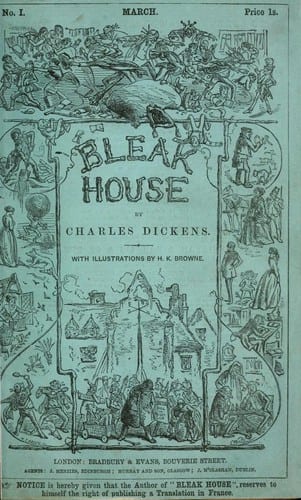
Bleak House keeps turning up in the culture whenever we talk about broken institutions and entrenched power, which is why its title still pops up in headlines like The Daily Beast’s recent riff on political debt and failure. Charles Dickens wrote it in the 1850s about a legal system that devours lives, yet the phrase “Bleak House” still feels uncomfortably current.
For listeners, that makes Bleak House a surprisingly sharp choice right now: a 67‑chapter Victorian marathon that plays like a prestige courtroom saga, a social novel, and an intimate memoir in one. In audio, its shifting voices, slow‑burn mystery around Jarndyce and Jarndyce, and Dickens’s dark jokes about lawyers and landlords all become a long, immersive series you can live inside for weeks.
Key facts
- Author
- Charles Dickens
- Genre
- General Fiction
- Published
- 1853
- Language
- English
- Chapters
- 67
What Bleak House is about, in plain language
At its core, Bleak House follows the fallout from Jarndyce and Jarndyce, a long‑running lawsuit over a tangled inheritance that drags on in the Court of Chancery. The case never quite resolves and instead shapes, distorts, or ruins the lives of almost everyone connected to it. That single legal dispute gives Dickens an excuse to move through London parlors, shabby offices, and fog‑filled streets while he tracks how money, status, and paperwork twist human relationships.
We watch all this from two distinct angles. One is the clear, modest voice of Esther Summerson, the novel’s heroine, who narrates her own life and the circles of friends and guardians around her. The other is an omniscient third‑person narrator who can swoop into Parliament, law chambers, or a miserable slum and report, often with biting irony, on what is happening. The interplay between Esther’s careful self‑presentation and the cooler, panoramic voice turns a potentially dense Victorian plot into something surprisingly dynamic in audio.
If you want a single hook to hold onto as you start listening, make it this: every new character and subplot, from the genial but depressive John Jarndyce to the menacing lawyer Mr Tulkinghorn, is caught in the gravitational pull of Jarndyce and Jarndyce. Keep that case in mind and the sprawling story stays coherent even when Dickens is throwing new minor characters at you every chapter.
“Every new character and subplot is caught in the gravitational pull of Jarndyce and Jarndyce.”
Charles Dickens in 1853 and where Bleak House sits in his career
Bleak House is the ninth novel by Charles Dickens, published in 20 monthly parts between March 1852 and September 1853. That serial rhythm matters when you listen today. Dickens was writing for readers who got a fresh installment each month, so nearly every chapter has a small arc or cliffhanger, some vivid new arrival, or a turn in the legal saga to keep people buying the next part.
By 1853 Dickens already had the popularity and technical control to build what many critics consider one of his “most complete” novels. Bleak House feels like a writer using his full range: grotesque caricature and pinpoint social observation, farce and melodrama, but also an unusually sustained interest in how institutions grind people down. Its genre is listed simply as General Fiction, yet within that label you can hear courtroom drama, social protest, romantic subplot, mystery, and satire all coexisting.
The Victorian context also explains the obsession with paperwork and process. The Court of Chancery in Dickens’s England was notorious for endless delays and astronomical costs, so readers in 1853 saw Jarndyce and Jarndyce as ripped from life, not exaggeration. When you listen now, the period details may feel antique, but the underlying frustration with a system that is too slow and too self‑interested to help ordinary people is immediately legible.
“Bleak House feels like Dickens using his full range, from grotesque caricature to pinpoint social observation.”
Spinn Radio
Listen to Bleak House on Spinn Radio
Key themes that make Bleak House feel modern
You can absolutely enjoy Bleak House as a densely plotted Victorian saga, but listening to it foregrounds a set of themes that still sting. The most obvious is institutional failure. Jarndyce and Jarndyce consumes fortunes and decades, and the people trapped in it become passive, bitter, or simply break. Dickens keeps circling the basic question: what happens when the system that is supposed to deliver justice turns into a machine for delay?
Character by character, he shows different responses. John Jarndyce, the kindly guardian whose home gives the book its title, tries to shelter younger people from the whole mess, yet the case still shadows his relationships and moods. By contrast, the lawyer Mr Tulkinghorn moves confidently inside the system, using knowledge and secrecy as power. Listening to their scenes back to back makes the moral contrast between weary decency and cold manipulation feel almost theatrical.
There is also a quieter theme running through Esther Summerson’s narration: how someone with little formal power constructs a self in the middle of all this. Her first‑person chapters are modest, even self‑effacing, but they keep pulling your attention back to small acts of care and loyalty that matter as much as the big legal climaxes. On audio, the shift between her intimate voice and the omniscient social panorama turns the book into an alternating current of public scandal and private resilience.
“On audio, Bleak House becomes an alternating current of public scandal and private resilience.”
What makes Bleak House work so well as an audiobook
With 67 chapters, Bleak House is a long haul in any format, yet it arguably plays to audio’s strengths. Each chapter has a clear setting, a small goal, or a striking character moment, a legacy of its original publication in 20 monthly parts. That built‑in rhythm makes it easy to listen in daily or weekly bursts. You can treat it like a very long, very Victorian limited series, complete with recurring locations and a large ensemble cast.
The book’s split narrative is another gift to audio. Esther Summerson’s chapters invite a close, conversational performance, while the third‑person sections have room for a more sardonic or sweeping delivery. Even if you are listening to a single‑narrator recording, you will hear the tonal switch: quieter, emotionally direct scenes around Esther contrasted with dryly funny or chilling passages in the all‑seeing voice. That variation keeps fatigue at bay over such a big runtime.
Finally, this is a novel rich in distinctive side figures, from the childish Harold Skimpole to the gloomy but friendly John Jarndyce. In print, it is easy to lose track of them. In audio, vocal cues and repeated encounters make them easier to remember. Many listeners find themselves waiting for the next appearance of a favorite minor character, which is exactly how Dickens designed the monthly experience.
“Treat Bleak House like a very long, very Victorian limited series, and the 67 chapters become a pleasure rather than a chore.”
How to approach the length and structure as a new listener
If the sheer size of Bleak House intimidates you, the key is to think in arcs, not pages. Because it was published between March 1852 and September 1853 in 20 parts, you can roughly divide your listening into 20 “episodes.” Each cluster introduces or resolves a few subplots around the central Jarndyce and Jarndyce case. Breaking it up this way makes the novel feel manageable and underscores how expertly Dickens balanced his ensemble.
It also helps to latch onto three or four names at the start. Make a mental note of Esther Summerson, John Jarndyce, Mr Tulkinghorn, and Harold Skimpole on your first sessions. Once those anchors are secure, the other minor characters feel like satellites rather than clutter. Within a few hours of listening you will start to sense patterns in how Dickens revisits settings and relationships, and from there the remaining chapters unfold with increasing momentum.
Good to know
Frequently asked questions
Who wrote Bleak House?
Bleak House was written by Charles Dickens. It is his ninth novel and is widely regarded as one of his most complete works.
What genre is Bleak House?
Bleak House is classified as General Fiction. Within that broad label it mixes legal drama, social commentary, and intricate character study.
When was Bleak House published?
Bleak House was published in 1853, after being issued in 20 monthly parts between March 1852 and September 1853. That serial origin shapes its chapter‑by‑chapter pacing.
How many chapters are in Bleak House?
Bleak House has 67 chapters. The large number reflects its original life as a long serial, designed to keep readers engaged over many months.
What is the main plot of Bleak House about?
The main plot of Bleak House centers on Jarndyce and Jarndyce, a long‑running legal dispute in the Court of Chancery. The case’s delays and intrigue affect an entire web of characters, including heroine Esther Summerson and her guardian John Jarndyce.
Shop the story
Reading Essentials
 Bestseller
Kindle Paperwhite (16 GB)
The fastest Kindle e-reader
View on Amazon
Kindle Paperwhite
Waterproof, glare-free reading
View on AmazonAs an Amazon Associate, Spinn Radio earns from qualifying purchases.