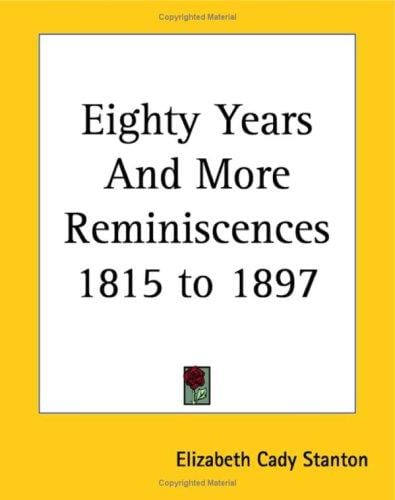
“Eighty Years and More; Reminiscences 1815-1897” does something contemporary histories of feminism often struggle to manage: it lets Elizabeth Cady Stanton speak for herself. In audiobook form, this 1898 memoir stops feeling like a remote document and starts to sound like a long, urgent conversation about power, freedom, and who gets written into the story.
Filed under Biography & Autobiography, Stanton’s 28 chapter account of her life and work with Susan B. Anthony is not a polite victory lap. It is the voice of a woman taking stock of eight crowded decades, from early domestic compromises to strategic decisions that still spark debate, and it lands differently when you hear it aloud.
Key facts
- Author
- Elizabeth Cady Stanton
- Genre
- Biography & Autobiography
- Published
- 1898
- Language
- English
- Chapters
- 28
What is “Eighty Years and More; Reminiscences 1815-1897” actually about?
At its core, “Eighty Years and More; Reminiscences 1815-1897” is Stanton’s own guided tour through the first great wave of the women’s rights movement. Written and published in 1898, it moves across 28 chapters of Biography & Autobiography that track her life from 1815 into the final years of the 19th century. You are not getting a biographer’s tidy summary. You are inside Stanton’s choices, doubts, and arguments as she remembers them.
She opens with a line that frames everything that follows: “Social science affirms that woman's place in society marks the level of civilization.” It is less an epigraph than a thesis. Across the chapters that follow, she uses her personal story to test that idea against marriage, motherhood, public speaking, and law. The takeaway is simple and sharp: if you want to know how civilized a society really is, start by asking what it expects of its women.
The book’s full title, with its years 1815 to 1897, is not decorative. It reminds you that this is a life that runs alongside seismic changes in voting rights, abolition, and reconstruction. Stanton positions her own memories inside that longer arc, making the audiobook feel like a first person time machine rather than a distant civics lecture.
“You are not getting a biographer’s tidy summary. You are inside Stanton’s choices, doubts, and arguments as she remembers them.”
Elizabeth Cady Stanton, Susan B. Anthony, and a 50, year partnership
One of the most compelling threads in “Eighty Years and More; Reminiscences 1815-1897” is not a single political battle but a relationship. Stanton dedicates the memoir “to Susan B. Anthony, my steadfast friend for half a century, ” and that dedication is the key to how to listen. This is as much a story of collaboration as it is of one woman’s life.
Stanton describes how, in the early years, she stayed home with “her husband and many babies” while Susan B. Anthony went from town to town delivering the speeches Stanton wrote. The division of labor is striking to modern ears. One woman crafts the arguments at a kitchen table, the other faces “an often hostile public” to deliver them. Hearing this spelled out in Stanton’s own framing makes the audiobook a study in how movements get built from unglamorous, unequal, but deeply committed work.
The crucial takeaway here is that women’s rights in the 19th century were not advanced by lone geniuses. They were advanced by partnerships like Stanton and Anthony’s, which weathered decades of strategic disagreements but never lost sight of the shared goal. The dedication at the front of the memoir is not sentimental. It is a political acknowledgment that a half, century of progress depended on two women pushing in concert.
“This is as much a story of collaboration as it is of one woman’s life.”
Spinn Radio
Listen to Eighty Years and More; Reminiscences 1815-1897 on Spinn Radio
The hardest chapter: race, the vote, and a controversial choice
Any honest introduction to “Eighty Years and More; Reminiscences 1815-1897” has to prepare new listeners for one of its most difficult episodes. When Black men were granted the vote in 1870, Stanton and Anthony chose to withhold support for a bill that expanded rights to Black men while continuing to exclude women of every color. That decision shaped their legacy and still shapes how many modern listeners hear Stanton’s voice.
Within the memoir’s broader story of perseverance, this moment lands like a cold shock. Stanton presents herself as someone who has fought for equality across decades, yet here she and Anthony draw a hard line against legislation that would enfranchise others before women. As you listen, it is worth holding two ideas at once: their work on women’s rights was foundational, and their position on the 1870 vote reflected painful limitations in their own politics.
The key takeaway for today’s listener is not to excuse or erase that stance, but to confront it. The audiobook gives you a front row seat to a movement that was visionary on gender and constrained on race. Because it is her own account, you have to grapple with Stanton as a complicated narrator of her own progress, not a perfectly edited heroine.
“The audiobook gives you a front row seat to a movement that was visionary on gender and constrained on race.”
Why Stanton’s 1898 memoir still feels urgent in audio
“Eighty Years and More; Reminiscences 1815-1897” has obvious historical significance, but its endurance has as much to do with tone as with dates. Stanton writes like someone who expects to be argued with, which makes the audiobook unusually alive. She is opinionated, occasionally wry, and constantly connecting private experience to public consequence.
Because this is Biography & Autobiography, not pure political theory, you hear how domestic life shapes the tempo of activism. Stanton’s references to “her husband and many babies” turn abstract debates about “woman’s place in society” into concrete images: a mother drafting speeches between feedings, a writer turning household constraint into rhetorical ammunition. Listening rather than reading amplifies that tension between the quiet of the home and the noise of the platform.
The takeaway here is that the memoir’s age does not blunt its edge. Many of the questions it raises about whose labor is visible, whose voice is amplified, and who is asked to wait their turn in movements for change still feel live. Hearing those questions stated in 19th century language, in a story that ends before women gain the vote in 1920, gives today’s listener an uncomfortable but productive distance.
“Stanton writes like someone who expects to be argued with, which makes the audiobook unusually alive.”
How to approach the 28, chapter listening experience
As an audiobook, “Eighty Years and More; Reminiscences 1815-1897” rewards patient, chapter by chapter listening instead of a single binge. Its 28 chapters move through childhood, marriage, organizing, and public controversy in a steady chronological line from 1815 to 1897. Think of it less as one long lecture and more as a series of intimate sessions with the same relentless mind.
A useful way in is to start with the opening chapters that frame her belief that “woman's place in society marks the level of civilization, ” then skip forward to the sections that cover her work with Susan B. Anthony. Once you have that partnership in your head, the later chapters about hard strategic choices, including their stance in 1870, land with more context. You can always circle back for the missing years, but hearing the arc of friendship and strategy first makes everything else easier to hold.
The final takeaway for listeners is simple: this is not background noise. It is a primary source autobiography, published in 1898, that asks to be listened to actively. Put it on when you can follow the thread, pause when you need to sit with a decision or a contradiction, and let Stanton’s 80, plus years of memory unsettle the tidy version of history you may have grown up with.
“Think of it less as one long lecture and more as a series of intimate sessions with the same relentless mind.”
Good to know
Frequently asked questions
Who wrote Eighty Years and More; Reminiscences 1815-1897?
Elizabeth Cady Stanton wrote “Eighty Years and More; Reminiscences 1815-1897.” It is her own autobiography, not a secondhand account by a later historian.
When was Eighty Years and More; Reminiscences 1815-1897 published?
“Eighty Years and More; Reminiscences 1815-1897” was published in 1898. That date means Stanton is writing almost to the end of the 19th century, before women gained the vote in 1920.
What genre is Eighty Years and More; Reminiscences 1815-1897?
“Eighty Years and More; Reminiscences 1815-1897” is classified as Biography & Autobiography. It is Stanton’s own narrative of her life and work in the women’s rights movement.
How many chapters are in Eighty Years and More; Reminiscences 1815-1897?
“Eighty Years and More; Reminiscences 1815-1897” contains 28 chapters. The structure lets listeners follow Stanton’s story from 1815 through 1897 in careful chronological stages.
What is Eighty Years and More; Reminiscences 1815-1897 about in simple terms?
“Eighty Years and More; Reminiscences 1815-1897” is about Elizabeth Cady Stanton’s life and her role in the early women’s rights movement. It covers her partnership with Susan B. Anthony, her family life, and the political choices that defined their campaign for suffrage.
Shop the story
Reading Essentials
 Bestseller
Kindle Paperwhite (16 GB)
The fastest Kindle e-reader
View on Amazon
Kindle Paperwhite
Waterproof, glare-free reading
View on AmazonAs an Amazon Associate, Spinn Radio earns from qualifying purchases.
Sources