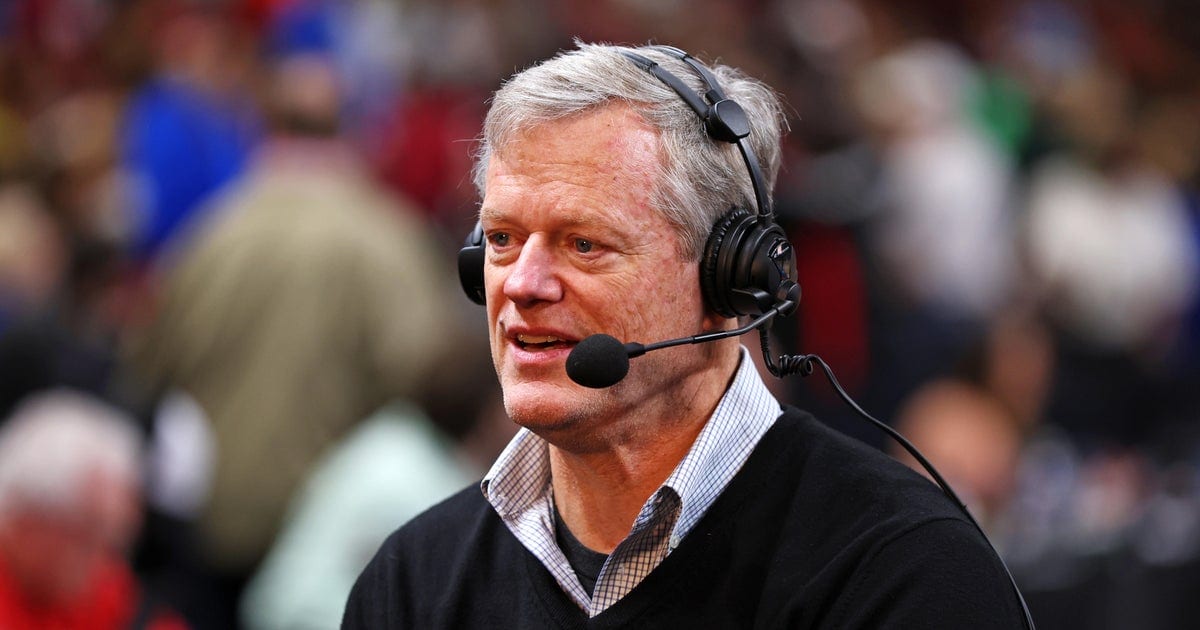
NCAA president Charlie Baker says he does not expect to rewrite the association’s rules on transgender athletes after a recent Supreme Court ruling that allowed states to move ahead with participation bans, according to an interview with CBS News. The comment signals that, for now, college sports’ most powerful governing body plans to hold its line even as legal and political pressure on transgender participation grows.
The ruling, reported by CBS News this week, cleared a path for states to restrict transgender athletes, yet Baker indicated he does not see an immediate need for the NCAA to adjust its current eligibility framework. That gap between state-level bans and national college rules sets up the next flashpoint in a debate that reaches from campus playing fields to Congress and the courts.
Key facts
- Source
- CBS News
- Reported
- July 1, 2026
- Desk
- general
- Follow the story
- Spinn Radio Talk
What Charlie Baker told CBS News about NCAA transgender rules
In his interview with CBS News, NCAA president Charlie Baker said he does not think the organization will need to change its rules on transgender athletes in response to the Supreme Court’s latest move. The ruling allowed states to ban participation by some transgender athletes, but Baker’s message was that the NCAA’s existing approach still stands.
That stance matters because the NCAA governs competition across hundreds of colleges and universities, while state laws vary widely on who can play on which teams. Baker’s comments suggest the association is not rushing into a rewrite, even as state lawmakers cite the Supreme Court development to justify new or existing restrictions. For college athletes and athletic departments, the signal from Indianapolis is continuity rather than immediate overhaul.
The key takeaway is that, as of this week, the NCAA’s leader is publicly tying future policy shifts to the association’s own assessment rather than to automatic changes triggered by the court’s decision.
“The key takeaway is continuity: Baker is signaling that the Supreme Court ruling alone will not automatically reset NCAA policy.”
How the Supreme Court ruling shapes state bans and college sports
CBS News reports that the Supreme Court ruling allowed states to ban participation by transgender athletes, a green light that has obvious consequences for school systems and youth sports. For college sports, the impact is more complicated, because NCAA competitions cross state lines and rely on a national rulebook.
If one state restricts transgender participation and another does not, schools in the same conference can face very different legal landscapes even when they play each other multiple times a season. The court’s move effectively expands the patchwork of rules that athletes must navigate long before they reach an NCAA championship event.
The immediate effect is not a rewritten NCAA manual but a widening gap between what some states permit and what the national college sports body currently allows. That tension is what administrators, athletes, and lawyers will be watching as state bans collide with established competition schedules.
Spinn Radio
Follow live news on Spinn Radio
What is at stake for transgender college athletes and teams
For transgender athletes on college campuses, Baker’s position means the NCAA’s formal rules are not changing right now, even as the legal environment around them shifts. The Supreme Court ruling, as reported by CBS News, gives states more latitude to block participation, which could limit opportunities long before athletes reach championship-level events.
Teams that recruit or compete across several states may now operate under one set of NCAA rules and a separate set of state laws. That can affect everything from travel rosters to where athletes feel safe and supported. Athletic departments and campus compliance offices are likely parsing how to honor both state requirements and NCAA standards in daily practice.
The clearest takeaway is uncertainty: while the NCAA’s rulebook is holding steady for the moment, the ground under athletes’ feet is moving as state policies respond to the Supreme Court decision.
“The clearest takeaway is uncertainty: a steady NCAA rulebook in a legal landscape that is anything but.”
Why the NCAA can hold its line even as states change course
Baker’s message to CBS News points to a structural reality of American sports governance. The NCAA is a private association that sets eligibility rules for its member schools, while the Supreme Court ruling focuses on what states may restrict under public law. Those are related but separate arenas.
Because of that separation, a state can enact a ban that shapes who can compete on public school teams or in certain competitions, yet the NCAA can decide that its own national championships will operate under its existing policies unless and until its members vote to change them. That does not erase the impact of state laws, but it lets the NCAA move on its own timeline.
The practical takeaway is that the Supreme Court ruling increases pressure on the NCAA to clarify how its rules interact with state bans, but it does not legally force an immediate rewrite. Baker’s comment makes clear he is not treating the decision as an automatic trigger for change.
What to watch next in the NCAA transgender athlete debate
The CBS News report sets up the next set of questions for college sports: whether state-level bans will begin to clash with NCAA postseason events, how conferences spanning multiple states respond, and whether member schools push for new national guidelines. Baker’s statement that he does not expect rule changes for now is a marker, not the final word.
Advocacy groups, lawmakers, and campus leaders are likely to seize on the Supreme Court ruling either to call for tighter participation rules or to defend current inclusion policies. That political and legal pressure will land at the NCAA’s doorstep as schools ask how to apply national rules in states that move aggressively to limit who can play.
For fans and athletes trying to keep up with a fast-moving story, the most useful step is to track how NCAA leaders talk about the issue over the coming months and how state legislation unfolds after the court’s decision. You can follow live news and talk on Spinn Radio for ongoing discussion as the policy debate around transgender athletes and college sports evolves.
“Baker’s statement is a marker, not the final word, in a debate that is now shaped by the Supreme Court as much as by campus rulebooks.”
Good to know
Frequently asked questions
What did Charlie Baker say about NCAA transgender athlete rules?
Charlie Baker said he does not think the NCAA will need to change its rules on transgender athletes in light of the recent Supreme Court ruling, according to CBS News. His comments signal that the association plans to keep its current framework in place for now.
How does the Supreme Court ruling affect transgender athletes?
The Supreme Court ruling allowed states to ban participation by some transgender athletes, as reported by CBS News. That opens the door to more state-level restrictions that can shape who gets to compete long before NCAA championships.
Why is the NCAA not changing its policy after the Supreme Court decision?
The NCAA is not changing its policy immediately because, as Baker told CBS News, he does not believe the ruling requires a rewrite of the current rules. The association can set its own eligibility standards even as states adjust their laws.
What should college sports fans watch for after this ruling?
Fans should watch how state bans on transgender participation interact with NCAA events and whether member schools push for new national guidelines. Baker’s latest comments are likely the start of an extended policy debate, not the conclusion.
Explore more on Spinn Radio: Follow live news and talk on Spinn Radio