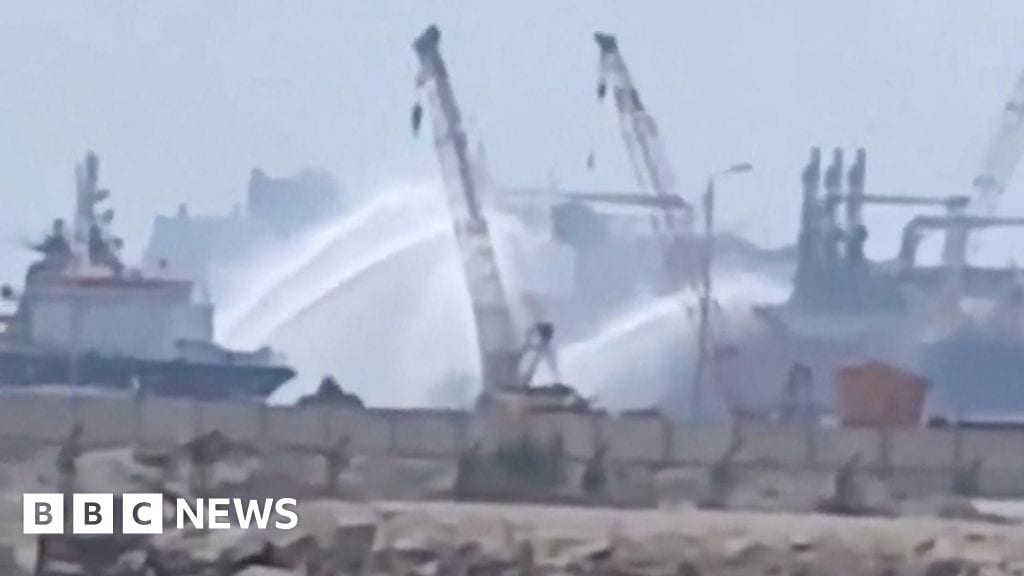
Egypt says a drone strike triggered a fire on two gas ships at the Mediterranean port of Damietta, according to reporting from BBC News on Thursday. Officials say the unmanned aircraft hit a US‑owned regasification vessel and a Greek‑owned tanker, an incident that immediately sharpened concerns over the security of commercial energy traffic off Egypt’s northern coast.
The reported attack, which BBC says took place on Wednesday, comes at a time when gas infrastructure and sea lanes across the region are under close scrutiny. Any disruption at Damietta, a major Egyptian port on the Mediterranean, carries potential knock‑on effects for shipping schedules and energy markets watching for signs of instability.
Key facts
- Source
- BBC
- Reported
- July 30, 2026
- Desk
- general
- Follow the story
- Spinn Radio Talk
What BBC reporting says happened at Damietta port
According to BBC News, Egyptian authorities say a drone struck two gas ships at Damietta, a key port city on Egypt’s Mediterranean coast. The aircraft reportedly hit a US‑owned regasification vessel, which is used to convert imported liquefied gas back into its gaseous form, and a Greek‑owned tanker in the same area.
The impact caused a fire on the vessels, Egyptian officials said, prompting an emergency response at the port. Details on damage, any casualties, or the status of operations at Damietta had not been fully disclosed in the initial reporting, underscoring how quickly the situation developed and how many questions remain.
The fact that both a US‑linked regasification ship and a Greek‑linked tanker were involved highlights how international the traffic through Damietta is. Even a single incident here can reverberate through shipping companies, insurers, and energy buyers who rely on quiet, predictable operations along the Egyptian coast.
“Two foreign‑owned gas ships hit by a single drone at Damietta is exactly the kind of incident that makes global shippers sit up and reassess risk.”
Why a drone attack on gas vessels in Egypt matters
Damietta sits on the Mediterranean, along routes that carry energy cargoes between North Africa, Europe, and beyond. A fire on two gas‑related vessels at this port, attributed by Egypt to a drone attack, is significant because it touches both maritime security and the stability of regional energy flows.
Regasification vessels, like the US‑owned ship reportedly hit, are a crucial part of how liquefied gas is imported and fed into domestic or regional networks. Tankers, like the Greek‑owned ship mentioned in the BBC report, move that fuel across long distances. Any perception that these kinds of ships are vulnerable near Egypt’s shores could feed into higher insurance costs or more cautious routing decisions by operators.
For Egypt, which positions itself as a hub for energy and trade in the eastern Mediterranean, an incident of this kind raises uncomfortable questions about airspace protection and port security. For global markets, the immediate concern is not only the damage done on Wednesday, but whether this signals a pattern that could affect other traffic in the area.
Spinn Radio
Follow live news on Spinn Radio
Who is involved and what we know about the ships
Officials quoted by BBC identify the vessels as a US‑owned regasification ship and a Greek‑owned tanker operating at or near Damietta when the drone hit. Ownership links the incident directly to foreign commercial interests that regularly move fuel through Egyptian waters.
Regasification ships are often chartered or owned by energy companies that need flexible import capacity. Tankers owned by Greek firms are a common sight on global routes, since Greek shipping companies hold a large share of the world’s commercial fleet. Even without specific company names in the early reporting, the national affiliations alone are enough to draw international scrutiny.
The Egyptian statement, as reported by BBC, centers on the fact that both ships were targeted in a single drone incident, rather than in separate events. That detail makes the case more serious for port authorities, because it points to a risk that is not limited to one vessel or one flag, but to the wider cluster of gas infrastructure operating off Damietta.
Security questions around drones and Mediterranean shipping
Drones have become an increasingly common tool in conflicts and in asymmetric attacks at sea, because they can be deployed at relatively low cost and over distance. Egypt’s claim that a drone caused the fire at Damietta places this incident squarely in a growing category of threats that port operators and navies now have to track more closely.
The Mediterranean is one of the world’s busiest enclosed seas, with tankers, container ships, and regasification vessels transiting between Europe, North Africa, and the Middle East. A drone strike affecting gas ships at an Egyptian port immediately raises questions about who launched it, how close it came to critical onshore facilities, and what defenses were in place.
For shipowners and charterers, the reported attack is another data point when they assess risk before entering a port. Even before the full picture is clear, Wednesday’s fire at Damietta will likely feature in conversations between captains, shipping firms, and insurers about operating procedures and contingency plans in the eastern Mediterranean.
“Once drones enter the equation at a port like Damietta, every tanker captain starts recalculating risk in real time.”
What to watch next as the Damietta investigation unfolds
The immediate focus in the coming days will be on clarifying the extent of the damage to the US‑owned regasification vessel and the Greek‑owned tanker, and on establishing whether port operations at Damietta are fully restored. BBC’s initial report did not spell out those details, which means shipping and energy analysts will be looking for follow‑up statements from Egyptian authorities or the ships’ operators.
Another key question is attribution: who is believed to have launched the drone, from where, and with what apparent objective. Egypt’s acknowledgment that a drone was involved puts pressure on security agencies to show how they will prevent similar incidents in the same busy stretch of coast.
For listeners and readers tracking fast‑moving international stories like this one, the easiest way to stay updated is to follow live coverage and analysis. Spinn Radio is keeping tabs on developments around Damietta on its news and discussion streams. You can Follow live news and talk on Spinn Radio to hear how this incident fits into wider regional security and energy conversations as more information emerges.
Good to know
Frequently asked questions
What happened at Egypt’s Damietta port?
Egypt says a drone hit two gas ships at Damietta port on the Mediterranean, starting a fire on the vessels. The incident involved foreign‑owned gas carriers and has raised concerns over security on vital shipping routes.
Which ships were struck in the reported drone attack?
Officials cited by BBC say a US‑owned regasification vessel and a Greek‑owned tanker were hit by the drone. Both were operating at or near Damietta when the incident occurred.
Why is a drone strike on gas ships in Egypt significant?
The reported drone strike is significant because it targeted gas vessels at a major Mediterranean port that handles international energy traffic. Any disruption there can affect shipping plans and heighten worries about the safety of regional gas infrastructure.
How can I follow updates on the Damietta port incident?
You can follow updates on the incident by tuning into Spinn Radio’s news and talk coverage. The story is being tracked on Spinn Radio Talk, which focuses on breaking news and analysis.
Explore more on Spinn Radio: Follow live news and talk on Spinn Radio
Sources