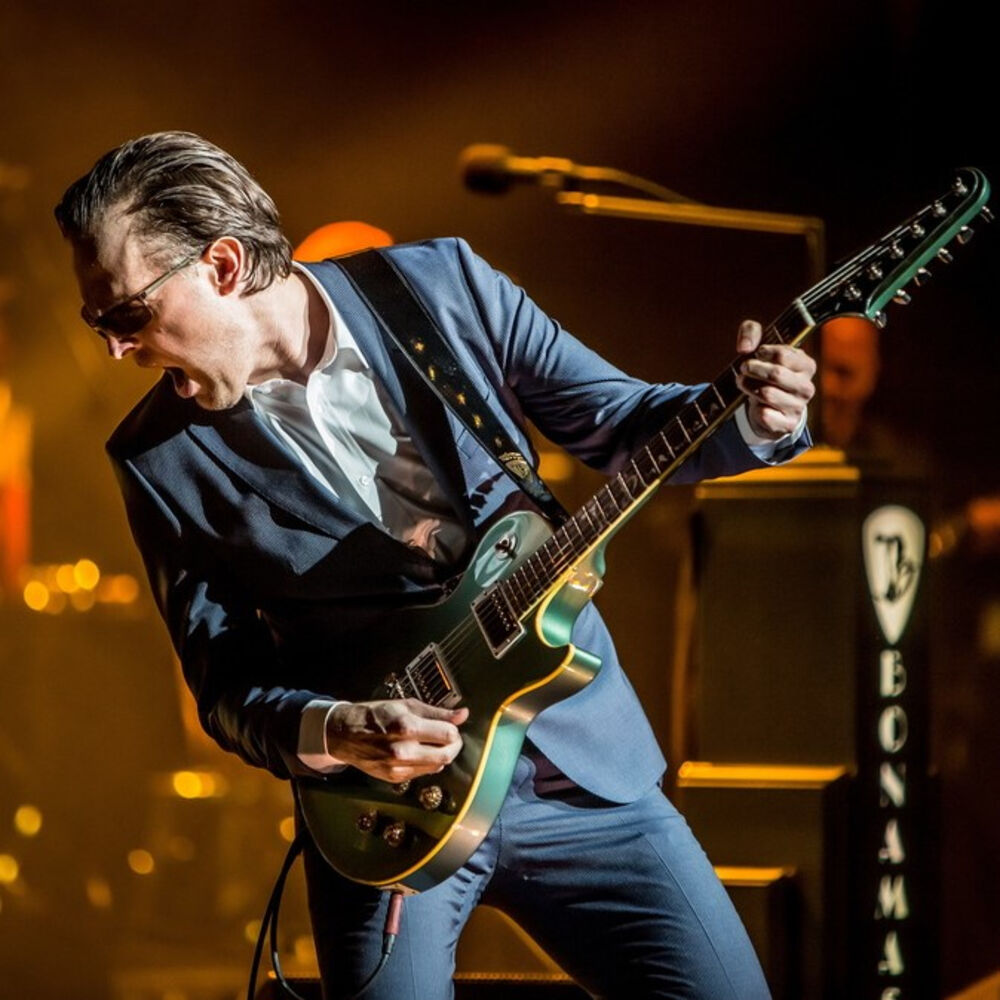
There's a version of the Joe Bonamassa story that sounds like a tall tale. A four-year-old in Utica, New York picks up a guitar because his father, a music-obsessed guitar dealer, keeps the house full of British blues records. By eleven, the kid is being mentored by Danny Gatton, the Telecaster wizard other guitarists spoke about in hushed tones. By twelve, he's fronting his own band, Smokin' Joe Bonamassa, and opening shows for B.B. King. None of it is a tall tale. All of it happened.
What makes Bonamassa remarkable, though, isn't the prodigy chapter. Plenty of gifted kids burn bright and vanish. It's what came after: two and a half decades of near-constant touring, an album-a-year work rate that would exhaust most bands, and a stubborn refusal to hand his career over to a major label. Today he's arguably the most commercially successful blues rock artist of his generation, with nearly half a million monthly listeners on Last.fm and a catalog deep enough to get lost in for weeks.
Key facts
- Born
- May 8, 1977, Utica, New York
- Genres
- Blues rock, blues, hard rock
- First guitar
- Age four, encouraged by his father
- Early mentor
- Guitar legend Danny Gatton, from age eleven
- Solo debut
- A New Day Yesterday (2000)
- Monthly Last.fm listeners
- Nearly 500,000
The kid with the record collection
Bonamassa's origin story runs through his father's turntable. While other kids his age were absorbing whatever was on the radio, young Joe was steeped in Eric Clapton and Jeff Beck, the British players who had taken American blues, cranked it through Marshall stacks, and sent it back across the Atlantic transformed. That Anglophile streak never left him. Where many American blues guitarists chase the Delta or Chicago sound, Bonamassa's playing has always carried that widescreen, rock-sized British inflection: the sustain, the drama, the volume.
The Danny Gatton apprenticeship sharpened the raw talent into something scary. Gatton was a musician's musician, a player of absurd technical range, and he taught Bonamassa discipline along with licks. The B.B. King support slots at twelve years old put the young guitarist in front of real audiences and, crucially, in the orbit of the blues' reigning statesman, who became a lifelong champion of his career.
The 1990s brought a detour: Bloodline, a band Bonamassa formed with the sons of several famous musicians. The group made one album and dissolved, but it gave the teenager a taste of the major-label machine, and, by most accounts, a healthy skepticism of it. That skepticism would end up defining everything that followed.
“Plenty of gifted kids burn bright and vanish. Bonamassa's real achievement is everything that came after the prodigy chapter.”
Building the machine
Bonamassa's solo debut, A New Day Yesterday, arrived in 2000, its title borrowed from a Jethro Tull song, a signal, right out of the gate, that his blues would always have one foot in classic rock. But the real turning point was structural, not musical. Together with his longtime manager Roy Weisman, Bonamassa built J&R Adventures, an independent operation that let him own his records, his touring, and his destiny. No label politics, no waiting for permission. If Joe wanted to make an album a year, he made an album a year.
And he did. Blues Deluxe in 2003, anchored by a smoldering take on the Jeff Beck Group tune that gave the album its name, announced him as a serious interpreter of the tradition. From there the records came at a relentless clip: Sloe Gin, The Ballad of John Henry, Black Rock, Dust Bowl, each one expanding the audience a little further. He worked for years with producer Kevin Shirley, whose big, cinematic sound became inseparable from the Bonamassa brand.
The moment the wider world caught up was May 2009, when Bonamassa headlined the Royal Albert Hall in London, the room forever associated with Cream and Clapton, and Eric Clapton himself walked out to join him onstage. For a player raised on British blues rock, it was the circle closing. The concert film from that night became a calling card, and the venues only got bigger from there, from Carnegie Hall to the Vienna Opera House to Red Rocks.
Spinn Radio
Listen to Joe Bonamassa on Spinn Radio
More than a solo act
For all the volume of his solo output, some of Bonamassa's best work happens in collaboration. Black Country Communion, his hard rock supergroup with Deep Purple's Glenn Hughes, drummer Jason Bonham and keyboardist Derek Sherinian, lets him play heavier and looser than his own records usually allow. Rock Candy Funk Party indulges his jazz-funk side. And his duo albums with singer Beth Hart, beginning with Don't Explain in 2011, revealed a generous accompanist behind the guitar hero: on those soul-drenched records, Bonamassa plays for the song and lets Hart's volcanic voice lead.
Then there's the offstage empire: the Keeping the Blues Alive Foundation, which funds music education and supports working musicians; the annual blues cruise that bears its name; and his famous guitar collection, a museum-grade hoard of vintage Les Pauls and amplifiers he affectionately calls Nerdville. Bonamassa isn't just a player in the blues world. At this point, he's part of its infrastructure.
The catalog kept growing through the 2020s Royal Tea, recorded at Abbey Road as a love letter to his British heroes, then Time Clocks and Blues Deluxe Vol. 2, the latter a full-circle return to the covers-heavy format that broke him twenty years earlier. The kid from Utica never stopped being a fan. He just built a career big enough to hold all of it.
Good to know
Frequently asked questions
How did Joe Bonamassa get famous?
A child prodigy from Utica, New York, Bonamassa started guitar at four, was mentored by Danny Gatton at eleven, and opened for B.B. King at twelve. His breakthrough came through relentless touring and the 2003 album Blues Deluxe, followed by his landmark 2009 Royal Albert Hall concert.
Is Joe Bonamassa signed to a major label?
No. Bonamassa releases his music through J&R Adventures, the independent company he built with manager Roy Weisman. That independence is central to his story and his prolific release schedule.
What bands has Joe Bonamassa played in?
Beyond his solo career, he played in Bloodline in the 1990s, co-founded the hard rock supergroup Black Country Communion with Glenn Hughes, plays in the jazz-funk outfit Rock Candy Funk Party, and has recorded several acclaimed duo albums with singer Beth Hart.
What is Joe Bonamassa's guitar collection called?
He calls his collection of vintage guitars and amplifiers Nerdville. It is regarded as one of the finest private collections of golden-era Gibson Les Pauls and vintage amps in the world.