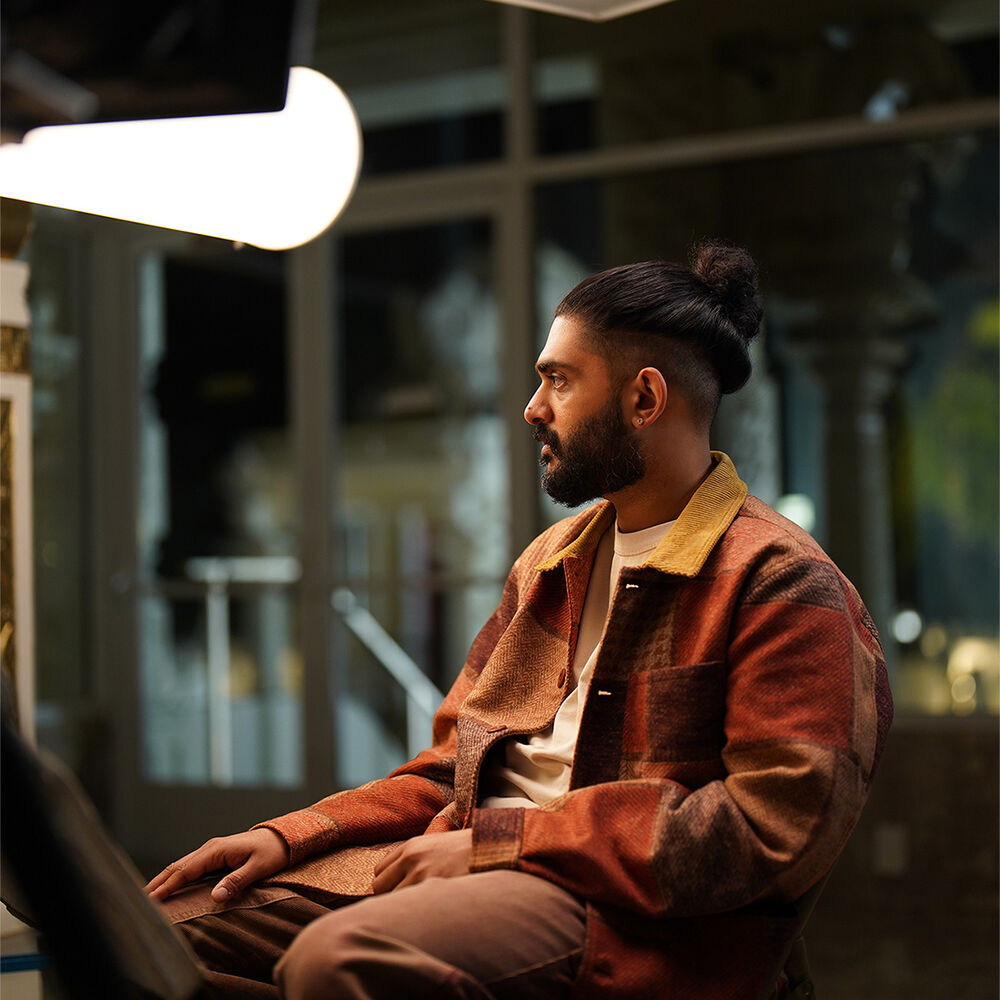
Most singers spend a career trying to find one voice. Sid Sriram grew up with two, and instead of choosing between them, he spent two decades proving they were never separate to begin with. On one side: the rigorous, devotional world of Carnatic music, which he began learning from his mother at age three. On the other: the American songbook of his adolescence, Lauryn Hill, Stevie Wonder, Justin Timberlake, Kanye West, absorbed growing up in the California Bay Area.
The result is one of the most distinctive voices in contemporary Indian music: a singer whose melisma carries the microtonal precision of a Carnatic gamaka one moment and the ache of a neo-soul falsetto the next. It's why his songs stop you mid-scroll, and why nearly 70,000 Last.fm listeners keep coming back to a catalog that refuses to sit still.
Key facts
- Born
- Chennai, India; raised in the San Francisco Bay Area
- First teacher
- His mother, a Carnatic vocal instructor, lessons began at age three
- Education
- Berklee College of Music, starting fall 2008
- Breakthrough
- "Adiye" from Kadal (2013), composed by A.R. Rahman
- Known for
- "Inkem Inkem Inkem Kaavaale", "Samajavaragamana", "Thalli Pogathey"
- Genres
- Playback, Carnatic, R&B, ambient pop
A childhood in two keys
Sriram's musical education started early and never really had an off switch. Carnatic vocal training is famously demanding, years of scales, ragas, and rhythmic discipline before a student earns the right to improvise, and he was steeped in it from toddlerhood, guided by his mother. But he was also a kid in Fremont, California, with American radio in his ears. Pop, R&B, hip hop, and jazz weren't a rebellion against his classical training; they were a parallel curriculum.
That dual fluency is rarer than it sounds. Plenty of artists sample across traditions; far fewer are genuinely trained in two. When Sriram enrolled at Berklee College of Music in 2008, he arrived not as a classical singer dabbling in soul or a soul singer with an exotic party trick, but as someone for whom both languages were native.
Berklee sharpened the production side of his brain, he'd go on to write, arrange, and produce much of his independent work himself, but the defining phone call of his career came from the other side of the planet.
The Rahman moment
A.R. Rahman has a long history of finding voices nobody else would have cast, and Sriram is one of his great discoveries. "Adiye, " from the 2013 Tamil film Kadal, introduced Indian audiences to a singer they couldn't quite place, the diction of an insider, the phrasing of an outsider, and an emotional directness that cut through everything. Rahman kept calling him back, and in 2016 "Thalli Pogathey" turned him from an intriguing new voice into a phenomenon.
What followed was one of the most dominant runs in modern playback singing. "Inkem Inkem Inkem Kaavaale" from Geetha Govindam became a Telugu-language juggernaut in 2018, the kind of song that plays at weddings, in headphones, and in a million cover videos simultaneously. "Samajavaragamana" from Ala Vaikunthapurramuloo repeated the feat in 2020. He became a first-call voice in Tamil, Telugu, and Malayalam cinema, a remarkable arc for someone raised eight thousand miles from Chennai.
“His melisma carries the precision of a Carnatic gamaka one moment and the ache of a neo-soul falsetto the next, two traditions, one throat.”
The other career
Here's the thing that makes Sriram genuinely unusual: while becoming one of South India's most in-demand playback singers, he never shelved the American half of his identity. He kept releasing independent English-language music, moody, ambient-leaning R&B that owes as much to his Berklee years as to his film work. Projects like Insomniac Season and Entropy showed a writer preoccupied with insomnia, longing, and the in-between spaces his two worlds created.
That thread culminated in Sidharth, his 2023 album for Def Jam, a record that folded Carnatic vocal runs, ambient textures, and raw soul into something with no obvious precedent. Songs like "Do The Dance" and "The Hard Way" introduced Western audiences to an artist Indian audiences already adored, and his profile in the US grew accordingly, from an NPR Tiny Desk performance to festival stages.
Spinn Radio
Listen to Sid Sriram on Spinn Radio
Why he matters now
The music industry loves a crossover story, but Sriram's isn't really a crossover, it's a refusal to accept the border in the first place. He still performs Carnatic concerts with full classical seriousness. He still delivers film songs that dominate South Indian charts. And he still makes left-field English records that sound like nobody else. For a generation of diaspora kids told to pick a lane, his catalog is a standing argument that you don't have to.
Whatever he releases next, another film smash, another ambient experiment, or something in between, the through-line will be the same: a voice trained in devotion, raised on soul, and entirely his own.
Good to know
Frequently asked questions
Where is Sid Sriram from?
He was born in Chennai, India, and raised in the San Francisco Bay Area in California. He grew up moving between both cultures, which shaped his blend of Carnatic music and American R&B.
How did Sid Sriram learn music?
He began learning Carnatic vocal music from his mother, a Carnatic teacher, at the age of three. He later studied at Berklee College of Music, which he entered in the fall of 2008.
What was Sid Sriram's first big film song?
His breakthrough was "Adiye" from the 2013 Tamil film Kadal, composed by A.R. Rahman. "Thalli Pogathey" (2016) then made him a household name.
Does Sid Sriram sing in English?
Yes. Alongside his playback career, he releases independent English-language R&B and ambient pop, including the 2023 album Sidharth on Def Jam.