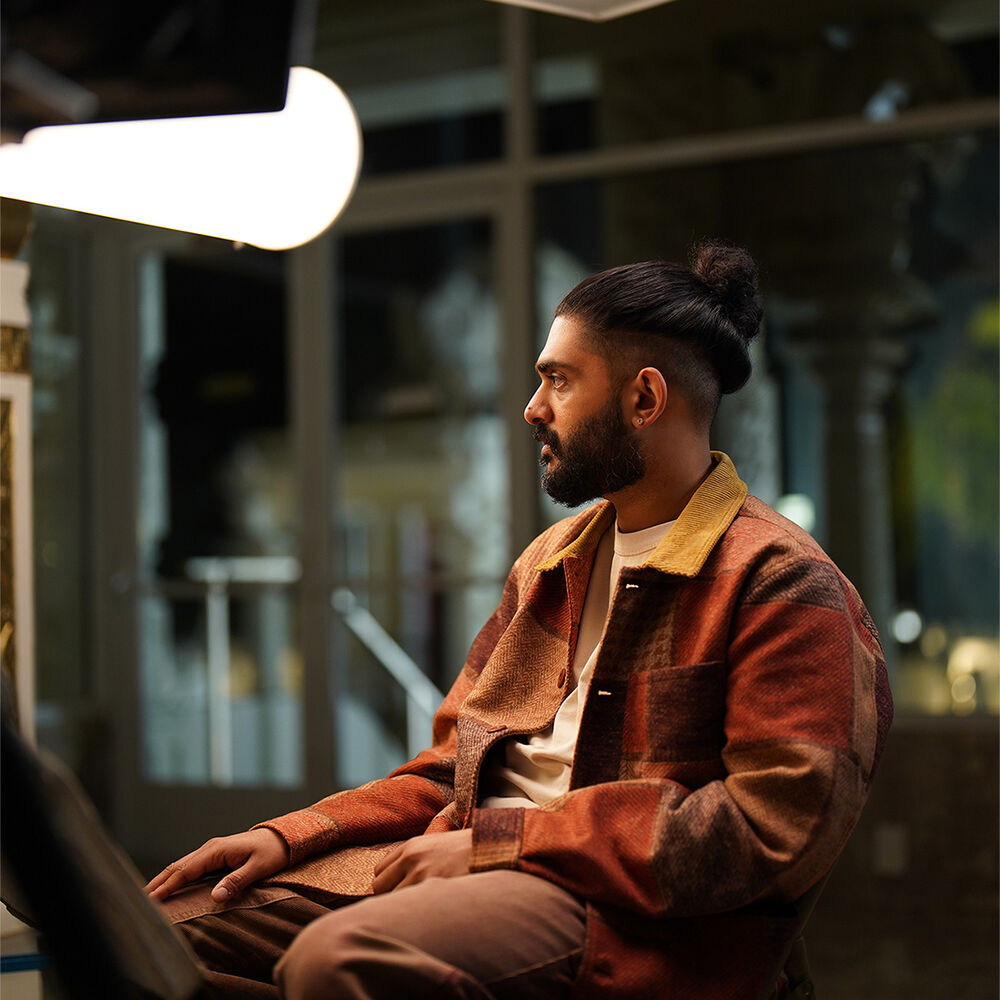
There's a particular moment in almost every Atif Aslam song, the point where his voice frays at the edges, cracks open just slightly, and somehow becomes more powerful for it. That controlled rasp is one of the most recognizable sounds in South Asian music, and it belongs to a man who, by his own account, spent his teenage years far more interested in cricket than singing.
Born in Wazirabad in Pakistan's Punjab and educated in Lahore and Rawalpindi, Atif Aslam attended PAF College Lahore, where the fast bowler's run-up mattered more to him than any melody. Music crept in slowly, then all at once. By the time he enrolled at the Punjab Institute of Computer Science in Lahore to study computer science, he had met a young guitarist and composer named Gohar Mumtaz, and the trajectory of Pakistani pop music was about to bend.
Key facts
- Born
- Wazirabad, Punjab, Pakistan
- Breakthrough
- "Aadat" with the band Jal, early 2000s
- Solo debut
- Jal Pari (2004)
- Genres
- Pakistani rock, soft rock, Bollywood playback, Sufi
- Honors
- Tamgha-e-Imtiaz, one of Pakistan's highest civilian awards (2008)
- Last.fm listeners
- Over 180,000
'Aadat' and the accidental revolution
The song that changed everything was "Aadat" a brooding, guitar-driven ballad Atif recorded with Jal, the band he formed with Mumtaz. In the early 2000s, Pakistani pop was in a strange in-between era, and "Aadat" landed like a lightning strike: raw, emotional, and unmistakably modern. It spread the way songs spread before streaming, burned CDs, radio requests, early internet forums, and made Atif's voice famous before most fans knew his face.
The partnership with Jal didn't last. Atif went solo, and his 2004 debut album Jal Pari proved the split had cost him nothing. The record confirmed what "Aadat" had suggested: this was a singer with an instinct for melody that couldn't be taught, paired with a voice that sounded lived-in even in his early twenties. Follow-up albums Doorie (2006) and Meri Kahani (2008) cemented him as the biggest solo act in Pakistani pop.
“Atif's voice sounded lived-in even in his early twenties, a rasp that carried heartbreak before he'd had time to earn it.”
Bollywood comes calling
India noticed quickly. "Woh Lamhe", a reworked version of the Jal-era material, appeared in the 2005 film Zeher and introduced Indian audiences to that voice. What followed was one of the most remarkable playback runs of the era. Working with composers like Pritam, Atif delivered hit after hit: "Pehli Nazar Mein" from Race, "Tu Jaane Na" and "Tera Hone Laga Hoon" from Ajab Prem Ki Ghazab Kahani, "Tere Liye", "Main Rang Sharbaton Ka", "Jeene Laga Hoon" songs that soundtracked a generation of Bollywood romance.
What made him different from the playback establishment was precisely that he wasn't from it. Atif never had formal classical training in the traditional sense; he sang like a rock frontman who happened to be handed love ballads. Where polished playback voices glide, his catches and burns. Directors and composers kept coming back because that imperfection read as sincerity, and audiences heard themselves in it.
Tajdar-e-Haram and the Sufi turn
If Bollywood made Atif a star, Coke Studio Pakistan made him something closer to a national institution. His 2015 rendition of "Tajdar-e-Haram" a qawwali made famous by the Sabri Brothers, became a phenomenon, the first Coke Studio Pakistan performance to cross one hundred million views on YouTube and a track that has since been streamed by listeners far beyond South Asia. It revealed a depth many casual fans hadn't suspected: the pop heartthrob could carry devotional music with genuine gravity.
That Sufi thread has run through his work ever since, from Coke Studio returns to live shows where a pop set will suddenly open up into ten minutes of qawwali-inflected improvisation. In 2008, Pakistan's government awarded him the Tamgha-e-Imtiaz, one of the country's highest civilian honors, recognition, at just 25, of how completely he had come to represent Pakistani music abroad.
Spinn Radio
Listen to Atif Aslam on Spinn Radio
Why he still matters
Two decades in, Atif Aslam occupies a rare position: he is claimed equally by Pakistan and India, by rock kids who grew up on "Aadat" and aunties who cry at "Tajdar-e-Haram, " by playlist romantics and Sufi purists. He even took a memorable acting turn in the acclaimed 2011 Pakistani film Bol. Few living singers bridge that many audiences without diluting themselves for any of them.
On Spinn Radio, his catalog sits alongside the artists he's shaped and been shaped by Arijit Singh, Rahat Fateh Ali Khan, Mohit Chauhan and it still sounds like nothing else. The cricket-mad kid from Wazirabad became the voice a subcontinent falls in love to. Not a bad career for a computer science student who only meant to jam between classes.
Good to know
Frequently asked questions
Where is Atif Aslam from?
Atif Aslam was born in Wazirabad, in Pakistan's Punjab province, and was educated in Lahore and Rawalpindi. He attended PAF College Lahore and later studied computer science at PICS Lahore, where he met Jal co-founder Gohar Mumtaz.
Was Atif Aslam in a band before going solo?
Yes, he co-founded the Pakistani band Jal with guitarist Gohar Mumtaz. Their song "Aadat" became a massive hit in the early 2000s, after which Atif launched a solo career with the 2004 album Jal Pari.
What is Atif Aslam's most famous song?
It depends who you ask: "Aadat" made him famous, Bollywood hits like "Tera Hone Laga Hoon" and "Tu Jaane Na" made him a superstar, and his Coke Studio rendition of "Tajdar-e-Haram" became one of the most-watched Pakistani performances ever on YouTube.
Has Atif Aslam won any major awards?
In 2008 he received the Tamgha-e-Imtiaz, one of Pakistan's highest civilian honors, alongside numerous music awards across Pakistan and India over his two-decade career.