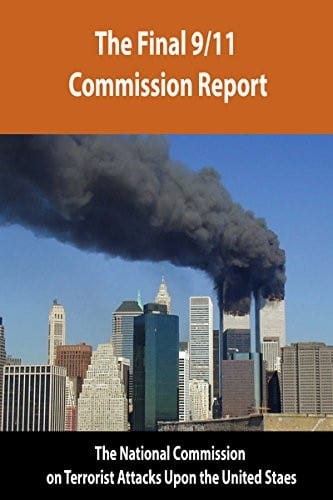
The 9/11 Commission Report is not a typical non-fiction title you queue up on a whim. It is the official account of the events leading up to the September 11, 2001 attacks, and in audio form it turns from government document into a sustained, unsettling act of witness.
Prepared by The 9/11 Commission and first issued in 2004, this report still shapes how people understand that morning and the failures before it. As an audiobook, its 57 chapters unfold like a slow, exacting reconstruction, the kind you absorb in silence rather than in the background while you cook.
Key facts
- Author
- The 9/11 Commission
- Genre
- *Non-fiction
- Published
- 2004
- Language
- English
- Chapters
- 57
What the 9/11 Commission Report actually is
Formally titled the Final Report of the National Commission on Terrorist Attacks Upon the United States, the 9/11 Commission Report is the United States government’s own attempt to explain how September 11 happened. Requested by the President and Congress, it was produced by a body often referred to as the "9/11 Commission" or the "Kean/Zelikow Commission." Every sentence carries the weight of that mandate: tell the country what led up to that day and what was missed.
The commission convened on November 26, 2002, 441 days after the attacks, and worked toward a single, public-facing document that anyone could read or listen to. That date is more than trivia; it reminds you that this was written in the immediate aftermath, with witnesses and officials still freshly marked by what they had seen.
Organized across 57 chapters, the report moves from the events of the day itself into intelligence gathering, policy decisions, and systemic vulnerabilities. As a listener, you are not just hearing about planes and timelines. You are hearing a government try to narrate its own shock, and its own responsibility.
“You are not just hearing about planes and timelines; you are hearing a government try to narrate its own shock, and its own responsibility.”
The author behind the report: who "The 9/11 Commission" really was
The listed author of the 9/11 Commission Report is The 9/11 Commission itself, the National Commission on Terrorist Attacks Upon the United States. That phrasing matters. This is not a single historian’s thesis or a journalist’s long investigation. It is an institutional voice, convened specifically to examine a national trauma.
Known informally as the 9/11 Commission or the Kean/Zelikow Commission, the body had a narrow brief: investigate the circumstances surrounding the attacks and issue a final report. The audiobook you hear is that final product, a collective document that tries to balance classified realities, political pressures, and a demand for clarity from the public.
Listening, you can hear the constraints and the care. The language is formal, sometimes procedural, but there are moments where the narrative tightens and you feel a very human urgency coming through the institutional tone. That tension between bureaucracy and emotion is part of what gives the audio version its strange, haunting power.
“This is not a single historian speaking to you, it is an institution trying to make itself understood.”
Spinn Radio
Listen to 9/11 Commission Report on Spinn Radio
How the 2004 era shapes the 9/11 Commission Report
The 9/11 Commission Report was published in 2004, when the attacks were still a fresh wound rather than distant history. That year is a crucial lens for any listener. Policies were changing in real time, and the public conversation about security, intelligence, and foreign policy was fierce and immediate.
Because it is a 2004 non-fiction document, the report reflects the priorities and language of that moment. You will not find decades of hindsight, later policy developments, or the long arc of how September 11 has been remembered. Instead, you get something rawer: a government speaking in the first draft of its own self-critique.
For listeners today, that 2004 timestamp turns the audiobook into a kind of time capsule. You hear how officials thought about risk, coordination, and failure just a few years after the attacks, with no guarantee that their recommendations would be followed. It is history, but it is also a snapshot of a government mid-course correction.
“The report feels less like a monument and more like a time capsule, sealed in 2004 and left for you to open in your headphones.”
Why the 9/11 Commission Report still matters now
Two decades on, the 9/11 Commission Report retains a particular grip because it is both non-fiction narrative and primary source. It explains, in measured English, how a chain of decisions and oversights can add up to catastrophe. That is why people keep returning to it: not for suspense, but for structure, the sense that someone tried to put chaos into order.
Its endurance also comes from its official status. This is the account that was presented to the public as the government’s own explanation. Agree or disagree with its framing, it remains a reference point for conversations about accountability, intelligence, and national security. When you listen, you are joining the same text that scholars, policymakers, and citizens have argued over since 2004.
For a modern audience that often experiences September 11 through clips and commemorations, the audiobook offers something slower and more demanding. It asks you to follow the chain of events and choices in full, chapter by chapter, without the shorthand of slogans or anniversary montages.
“It explains not just what happened, but how a long chain of small decisions can quietly set the stage for disaster.”
What it feels like to hear the 9/11 Commission Report as audio
As an audiobook, the 9/11 Commission Report turns a dense non-fiction text into a sustained listening experience that is both absorbing and draining. The English prose is clear and functional, designed to be understood rather than admired, which makes it surprisingly well suited to voice. Read aloud, the dry official language acquires an eerie calm that stands in contrast to the events it describes.
The 57 chapters naturally break the narrative into digestible sessions. You might take one or two chapters on a commute or in a quiet evening, then step away to process what you have heard. It is not easy listening, but it is steady. The repetition of dates, agencies, and locations becomes a kind of rhythm that helps you keep track of a complex story.
More than anything, hearing this report rather than reading it alone on the page changes your relationship to it. The institutional voice becomes intimate, almost confessional, in your headphones. You are not skimming; you are being told, out loud, how a country has chosen to remember one of its hardest days. That intimacy is the best reason to experience this landmark non-fiction work in audio form.
“On audio, the government’s official voice moves from distant and abstract to something unnervingly close, speaking directly into your ear.”
Good to know
Frequently asked questions
What is the 9/11 Commission Report?
The 9/11 Commission Report is the official Final Report of the National Commission on Terrorist Attacks Upon the United States, explaining the events leading up to September 11, 2001.
Who wrote the 9/11 Commission Report?
The 9/11 Commission Report was written by The 9/11 Commission, formally known as the National Commission on Terrorist Attacks Upon the United States.
When was the 9/11 Commission Report published?
The 9/11 Commission Report was published in 2004, just a few years after the September 11, 2001 attacks.
How many chapters are in the 9/11 Commission Report?
The 9/11 Commission Report contains 57 chapters, which structure the investigation into distinct sections for readers and listeners.
What genre is the 9/11 Commission Report?
The 9/11 Commission Report is a non-fiction work, presenting a factual, official account rather than a dramatized or fictional retelling.
Sources