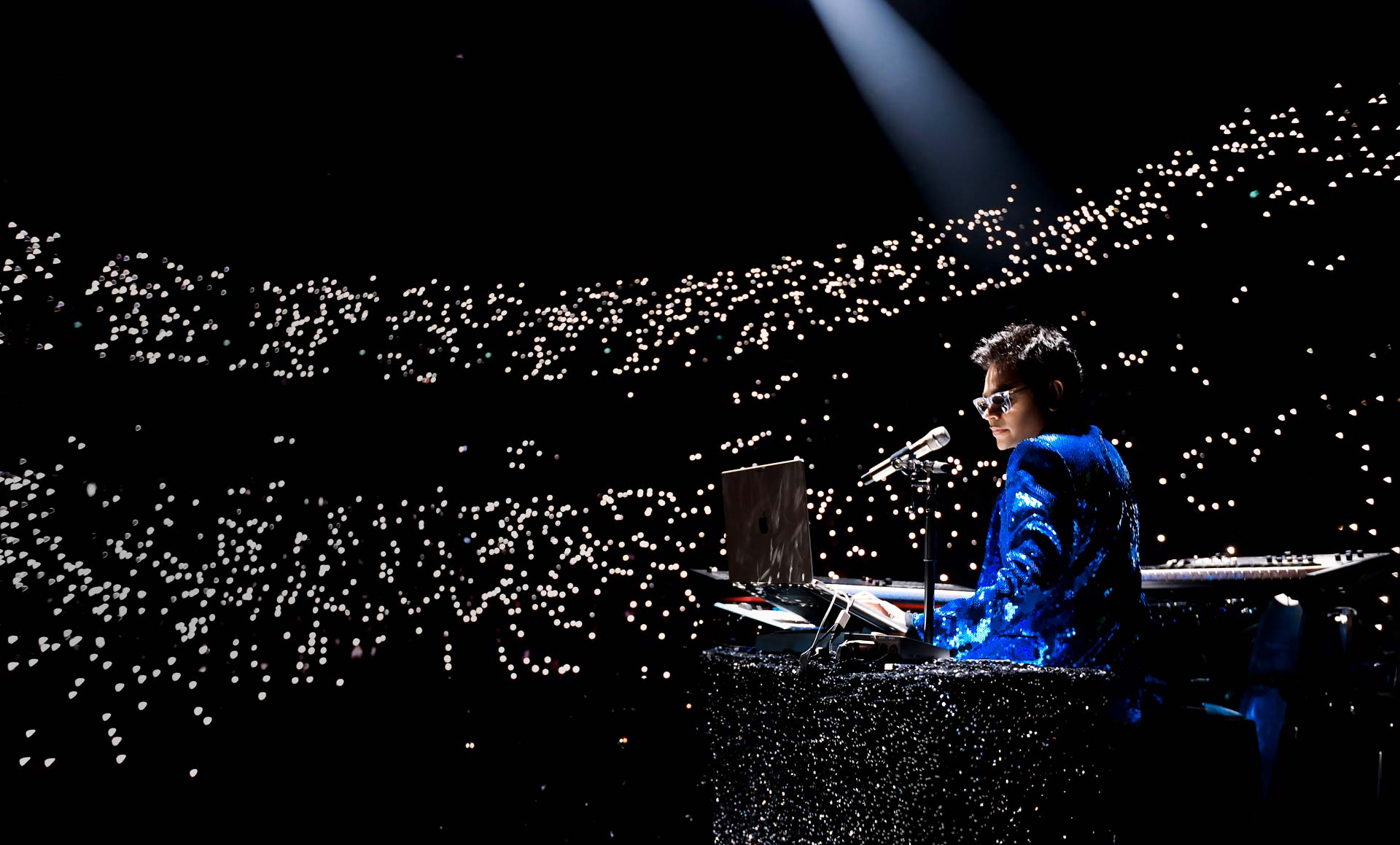
A.R. Rahman does not really release singles so much as he resets the emotional temperature of entire films. Even now, with hundreds of scores behind him and millions of plays online, tracks like “Jai Ho! (You Are My Destiny)” or “Kun Faya Kun” still feel like fresh reference points for what a modern Indian soundtrack can sound like.
Streaming numbers back it up. With roughly 683.9K monthly listeners and 17.8M total scrobbles, Rahman remains a daily habit for fans who treat his catalog as both mood board and memory bank. If you care about how Bollywood, Hindi and wider Indian soundtracks have absorbed electronics, global pop and devotional intensity, you eventually end up at A.R. Rahman.
Key facts
- Monthly listeners
- 683.9K
- Total scrobbles
- 17.8M
- Genres
- Soundtrack, Indian, bollywood, Hindi, A R Rahman
- Signature tracks
- Jai Ho! (You Are My Destiny), Tere Bina, Enna Sona, Kun Faya Kun, Riots
What makes A.R. Rahman’s soundtracks feel so different?
At the core of A.R. Rahman’s music is a habit of hybrid thinking. His scores are known for mixing eastern classical ideas with electronic textures, world music colors and full orchestral arrangements, sometimes within a single cue. You can hear it clearly in “Riots, ” where tense rhythm programming and cinematic strings collide to paint a scene that is both modern and deeply dramatic.
Rahman also writes with singers in mind, which keeps even dense arrangements feeling human. A ballad like “Tere Bina” sits on top of rich harmonic movement and subtle production detail, but what you remember first is the melody, almost devotional in its arc. That balance of high-end studio craft and instantly, singably simple hooks is why listeners can loop his songs for years without burning out.
If you want to understand the difference in one sitting, jump between “Riots” and “Enna Sona.” The former leans into anxious, almost thriller-like tension, while “Enna Sona” relaxes into warm, romantic comfort. Same composer, same instinct for drama, completely different emotional climate.
“He writes like a producer and produces like a composer, which is why a single Rahman track can feel as big as an entire film.”
Five essential A.R. Rahman tracks to queue right now
Start with “Jai Ho! (You Are My Destiny).” Beyond its status as a global earworm, the track is a microcosm of Rahman’s style: propulsive rhythm, chanted hooks, melodic lines that pull from Indian tradition, and a pop structure that feels instantly familiar even if you do not speak the language. It is the song that turned his soundtrack work into a worldwide calling card.
Then move to “Tere Bina, ” a slow-blooming love song where his melodic sense takes center stage. Listen for how the arrangement never stops evolving, from gentle openings to fuller, sweeping passages that still leave plenty of space for the vocal. It is a lesson in how to be lush without ever getting heavy.
“Enna Sona” shows Rahman in comfort-mode romanticism, leaning into smooth, Hindi-pop territory and a relaxed groove that still carries his signature harmonic color. After that, put on “Kun Faya Kun.” It is the spiritual anchor in many listeners’ Rahman playlists, devotional and hypnotic, the kind of song that quietly re-centers a long day. Finally, revisit “Riots” to hear his scoring brain at full power, free of traditional verse-chorus expectations and focused entirely on picture and tension. Each of these five tracks hits a different corner of his musical map: global pop, romance, easy-listening Hindi, spiritual, and pure soundtrack scoring.
“Across “Jai Ho!, ” “Tere Bina, ” “Kun Faya Kun, ” and “Riots, ” you can hear one composer rewriting how big feelings sound on screen.”

Spinn Radio
Listen to A.R. Rahman on Spinn Radio
Where A.R. Rahman fits among Indian soundtrack greats
Rahman is often introduced as a singular figure, but he sits inside a very active lineage of Indian soundtrack innovators. Fans who arrive through his work often branch out to contemporaries like Yuvan Shankar Raja, who also blends modern production with strong melodic writing, or Santhosh Narayanan, known for experimental touches and bold sound design in Tamil cinema.
On the Hindi and Bollywood side, Rahman shares space with composer collectives and producers who similarly treat film music as a playground. Shankar-Ehsaan-Loy have taken a rock-band approach to big scores, while Pritam leans heavily into pop hooks and radio-first thinking. Compared to them, Rahman often feels a bit more orchestral, more harmonically dense, and more prone to long-form development, which is why his instrumentals land so hard even without visuals.
That ecosystem makes Rahman more interesting, not less. Hearing his catalog in parallel with these peers highlights just how distinctive his palette is: colder electronics rubbing against warm strings, unexpected chord turns appearing inside otherwise straightforward love songs, and a willingness to let songs like “Kun Faya Kun” stretch into something almost meditative.
“Play Rahman back-to-back with Pritam or Shankar-Ehsaan-Loy and you hear it clearly: same industry, totally different gravitational pull.”
How A.R. Rahman bends genres inside one career
Officially, Rahman sits in the “Soundtrack” and “Indian” buckets, with tags like bollywood, Hindi and even simply “A R Rahman” orbiting his name. In practice, his work keeps slipping across genre lines. A track such as “Jai Ho! (You Are My Destiny)” reads as pop to casual listeners, while “Riots” is pure score, and “Kun Faya Kun” functions as spiritual music in many fans’ playlists.
This cross-genre appeal is built from small choices. Electronic beats give younger listeners a familiar entry point, orchestral arrangements signal classic movie grandeur, and the use of eastern classical ideas grounds everything in a distinctly Indian emotional language. That is why “Tere Bina” can sit comfortably next to global ballads in a playlist, even as its melodic DNA is very particular to Rahman’s context.
If you are building your own Spinn Radio mix, treat these genre labels as clues rather than walls. Slot “Enna Sona” into a Hindi pop set, “Riots” into a cinematic study playlist, and “Kun Faya Kun” into a late-night, reflective run of songs. You will start to hear how Rahman quietly expands what each category can hold.
“Rahman lives in the soundtrack aisle, but his songs keep leaking into pop, devotional and chill playlists all at once.”
Where to start with A.R. Rahman on Spinn Radio
For new listeners, a simple entry route is a five-track starter pack: “Jai Ho! (You Are My Destiny)” for the big, global hook; “Tere Bina” for intimate romance; “Enna Sona” for laid-back Hindi pop; “Kun Faya Kun” for the spiritual slow-burn; and “Riots” to feel his pure scorer instincts. Play them in that order to move from public anthem to private reflection.
From there, use the platform’s recommendations to fan outward. If the electronic and orchestral blend of “Riots” hits you, follow composers like Yuvan Shankar Raja and Santhosh Narayanan. If the song-first warmth of “Enna Sona” is your thing, explore more work from Pritam and Shankar-Ehsaan-Loy. You will notice how Rahman often sits at the intersection of their strengths.
Across hundreds of scores, he has made a particular promise to listeners: that a film song can be as texturally rich as any experimental record and still hit with the clean emotional force of a classic melody. Tune in for the lush string swells and beat drops, stay for the way a line from “Tere Bina” or “Kun Faya Kun” lingers long after you stop the stream.
“Start with five songs, and you might find that A.R. Rahman quietly becomes the backbone of your soundtrack listening.”
Good to know
Frequently asked questions
Who is A.R. Rahman?
A.R. Rahman is an Indian film composer, record producer, musician, singer and philanthropist. He is widely known for soundtrack work that blends eastern classical music with electronics, world genres and orchestral arrangements.
When was A.R. Rahman born?
A.R. Rahman was born on 6 January 1966. He was born as A. S. Dileep Kumar in Chennai, India.
What genres does A.R. Rahman compose in?
A.R. Rahman works mainly in Soundtrack and Indian music genres. His catalog is also closely linked with bollywood and Hindi tags on streaming platforms.
What are A.R. Rahman’s most popular songs?
A.R. Rahman’s signature tracks include “Jai Ho! (You Are My Destiny), ” “Tere Bina, ” “Enna Sona, ” “Kun Faya Kun” and “Riots.” These songs cover everything from global pop anthems to spiritual and cinematic pieces.
How many people listen to A.R. Rahman online?
A.R. Rahman has about 683.9K monthly listeners and 17.8M total scrobbles. Those numbers reflect how often fans return to his soundtrack work.
Explore more on Spinn Radio: Yuvan Shankar Raja · Santhosh Narayanan · Shankar-Ehsaan-Loy · Pritam