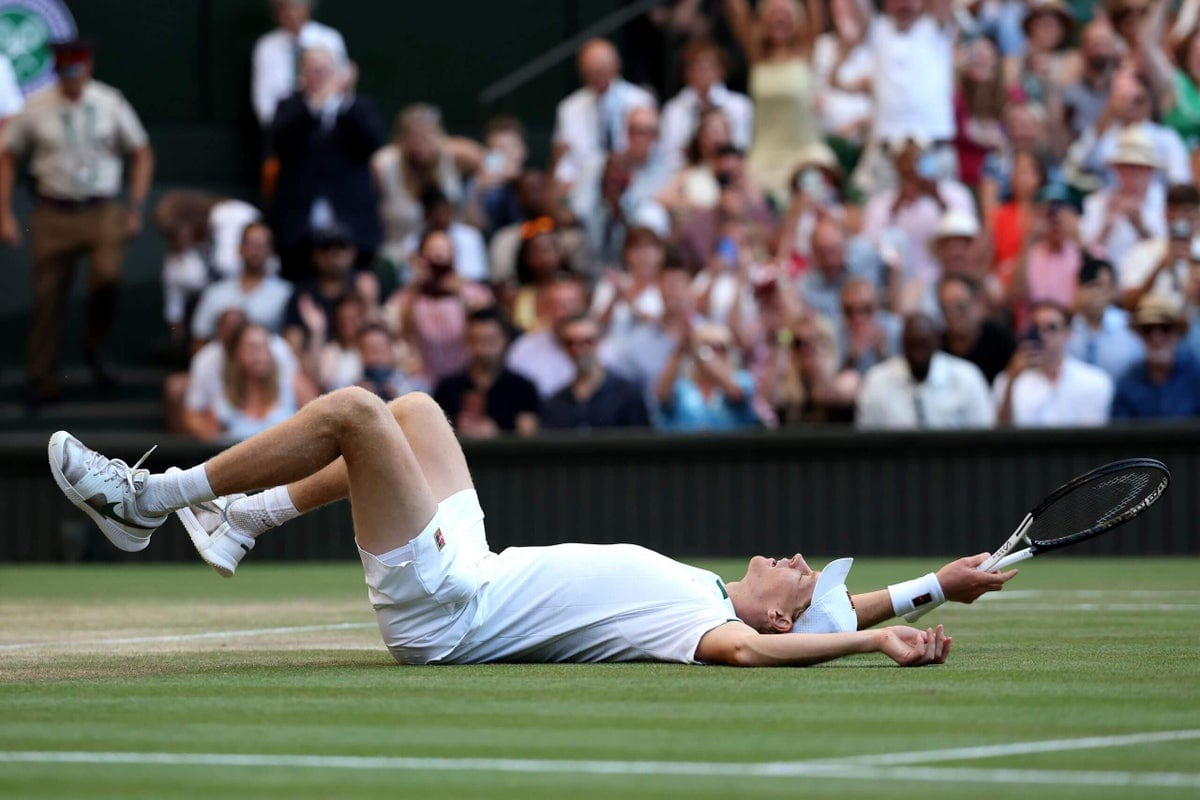
Jannik Sinner staged a comeback in the Wimbledon final to beat Alexander Zverev and successfully defend his title, The New York Times reported. The defending champion overturned a one‑set deficit to claim his fifth major trophy and extend his grip on grass at the sport’s most storied event.
The result also shut down Zverev’s pursuit of a rare “Channel Slam, ” the back‑to‑back sweep of Roland Garros and Wimbledon, sharpening an already charged rivalry at the top of the men’s game.
Key facts
- Source
- The New York Times
- Reported
- July 12, 2026
- Desk
- general
- Follow the story
- Spinn Radio Tennis
What Sinner’s fifth major means for the men’s game
Sinner’s victory, as described by The New York Times, moves him to a career total of five major titles. That number places him firmly in the sport’s power structure and confirms that last year’s Wimbledon breakthrough was not a one‑off. Defending on grass after falling behind a set is a test of nerve as much as form, and Sinner passed it under the weight of expectation that comes with walking back into a Centre Court final as champion.
The comeback also matters for how the tour stacks up. With another Grand Slam now on his résumé, Sinner strengthens his claim as a central figure in the post‑“Big Three” era. Each additional major widens the gap to peers who are still chasing a first or second title and raises the stakes every time he steps into a best‑of‑five match at a Slam. Fans tracking the long‑term storylines will file this win as a turning point in how the next decade of men’s tennis could look.
“Defending on grass from a set down is a test of nerve, and Sinner passed it with a fifth major on the line.”
How Sinner turned a one‑set deficit into a Wimbledon defense
The New York Times report made clear that this was not a straightforward defense. Sinner dropped the opening set to Zverev, a player riding the confidence of a recent Roland Garros triumph, and had to rebuild the match from behind. That kind of reversal in a Wimbledon final is about tactical adjustment but also about handling the emotional swing of a slow start in front of a global audience.
Coming back from a set down in a major final often hinges on winning key moments early in the second set and then tightening control as the opponent feels the match tilt. While the details of individual games are still emerging, the overall arc is already clear: Sinner absorbed Zverev’s early surge, then raised his own level enough to flip the momentum and run off the remaining sets. For a defending champion, that sort of resilience can be as significant as any technical strength.
“Sinner did more than hold serve as defending champion, he rewrote a final that was slipping away after one set.”
Spinn Radio
Follow Tennis on Spinn Radio
Alexander Zverev’s Channel Slam bid ends on grass
Zverev entered this Wimbledon final chasing a “Channel Slam, ” the shorthand for winning Roland Garros in Paris and Wimbledon in the same season. According to The New York Times, Sinner’s victory shut that door. It is one of the hardest feats in tennis because it demands mastery on slow red clay and then on fast grass within a matter of weeks, with no let‑up in pressure or physical load.
That Zverev was in position to attempt it at all underscores how strong his current season has been. Falling one match short, especially after leading by a set, will sting. In sporting terms, this loss now becomes the hinge in his 2026 campaign: had he closed it out, the narrative would be domination across two majors; instead, the story shifts to how he responds from here. For fans, it adds another layer to every future Slam draw that puts Zverev and Sinner in the same half.
“The Channel Slam was one match away, but Sinner’s turnaround on grass snapped Zverev’s run cold.”
Why defending Wimbledon matters so much for Sinner
Defending a Wimbledon title has always carried symbolic weight, and Sinner’s successful repeat, as reported by The New York Times, places him in a more exclusive conversation. The jump from four to five majors is statistically important, but doubling up at the same Slam on grass also signals that his game is not just adaptable, it is durable under the most traditional spotlight in tennis.
For Sinner’s legacy, this win does two things right away. First, it strengthens his claim to a long‑term relationship with Wimbledon, where champions are often judged by their ability to return and win again. Second, it sets a benchmark other players must measure themselves against on grass. Every July that he returns as a past champion, this successful defense will be the reference point for his rivals and for fans tracking his career arc.
“By backing up last year’s run, Sinner traded in the label of breakthrough for something sturdier: a genuine Wimbledon reign.”
What to watch next after this Wimbledon final
With Wimbledon wrapped, attention shifts to how both men carry this result into the rest of the season. For Sinner, the immediate storyline is whether this fifth major becomes the launch pad for an even larger haul, or a peak he has to protect. For Zverev, the key question is how quickly he can reset after watching a potential clay‑grass double vanish one match short.
Fans looking to keep up with the fallout from this final, and with the broader calendar that now moves from grass to hard courts, can track every update and storyline with Follow Tennis coverage on Spinn Radio. The Wimbledon result is set, but the rankings shifts, scheduling choices, and lingering aftershocks will play out across the rest of 2026.
“The final is over, but the real test is how Sinner and Zverev carry this match into the rest of the season.”
Good to know
Frequently asked questions
Who won the latest Wimbledon men’s singles final?
Jannik Sinner won the latest Wimbledon men’s singles final. He came back from a set down against Alexander Zverev to defend his title and earn a fifth major.
How did Jannik Sinner defend his Wimbledon title?
Sinner defended his Wimbledon title by rallying from one set down to beat Alexander Zverev in the final. The comeback secured his fifth major trophy.
What was Alexander Zverev trying to achieve with a win here?
Alexander Zverev was trying to complete the Channel Slam with a Wimbledon victory. That would have added a grass‑court major to his Roland Garros title in the same season.
Why is Sinner’s fifth major significant for his career?
Sinner’s fifth major is significant because it confirms his status among the sport’s leading players. Back‑to‑back Wimbledon titles give him a lasting foothold on grass.
Explore more on Spinn Radio: Follow Tennis coverage on Spinn Radio
Sources