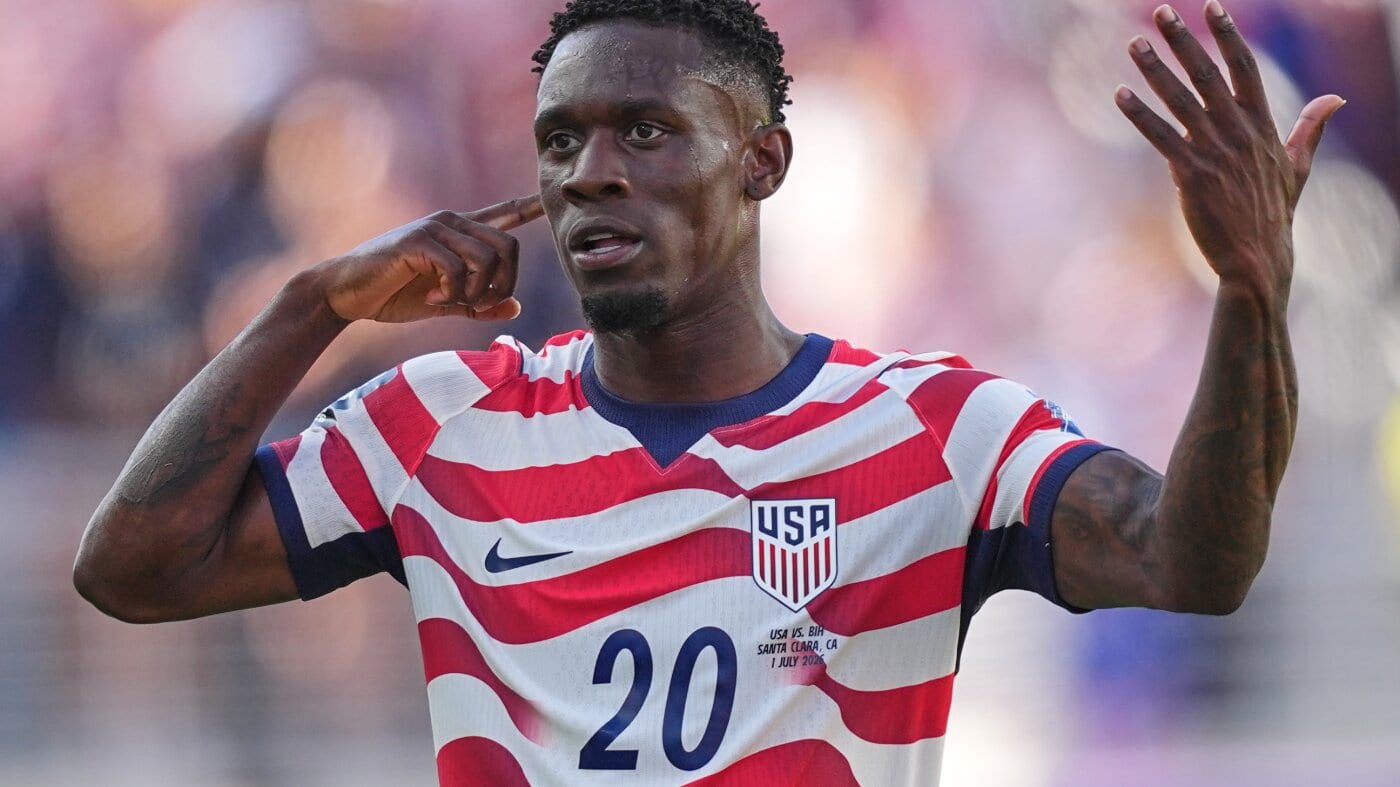
Folarin Balogun is eligible to play against Belgium after FIFA’s Disciplinary Committee chose to delay his one-game red card suspension, NPR reported this week. The decision means the United States can call on a first-choice striker in a key meeting with a European power.
NPR reports that the move followed a conversation between President Trump and FIFA President Gianni Infantino, an unusually direct political intervention in a disciplinary case. With the ban now lifted for the upcoming match, attention shifts to how much influence off-field power should carry in world soccer.
Key facts
- Source
- NPR
- Reported
- July 6, 2026
- Desk
- general
- Follow the story
- Spinn Radio Soccer
Why FIFA delayed Folarin Balogun’s red card ban
According to NPR, FIFA’s Disciplinary Committee opted to delay Folarin Balogun’s automatic one-game suspension that followed a red card. A red card normally triggers a straightforward ban, typically served in the next official match. In this case, FIFA has chosen to postpone that punishment so Balogun is available to face Belgium, a high-profile opponent for the United States.
What makes this notable is the timing and impact. Rather than missing the immediate next fixture, Balogun now remains selectable for a marquee game against a top European side. For the U.S. setup, that is the difference between leading the line with a primary attacking option and improvising with an altered front line in a statement match.
“Delaying a red card suspension so a striker can face Belgium is the kind of exception that gets the entire sport talking.”
How a Trump, Infantino conversation shaped the outcome
NPR reports that the delayed ban followed a direct conversation between President Trump and FIFA President Gianni Infantino. Presidential involvement in a single-player disciplinary case is highly unusual, even in a sport that often brushes up against politics and diplomacy.
By linking the outcome to that call, the report raises questions about how much weight political leaders can carry when they step into football governance. Fans and analysts will be asking whether this was a one-off intervention tailored to Balogun and this specific match, or a precedent that could prompt future lobbying around suspensions and eligibility.
For supporters tracking the bigger picture of governance and influence in the sport, this is a story that sits alongside broader debates about how decisions are made inside FIFA and who gets a seat at the table when those decisions touch the national teams of major countries.
“Presidential involvement in a one-game ban turns a routine disciplinary decision into a global talking point.”
Spinn Radio
Follow Soccer on Spinn Radio
What Balogun’s availability means for the U.S. against Belgium
On the field, the biggest immediate takeaway is simple: the United States can plan for Belgium with Balogun in the squad. For coaches, that affects everything from the starting XI to set-piece routines, since the system can be built around a recognized central striker instead of a makeshift solution.
Belgium offers a test of how the U.S. stacks up against a European heavyweight. Having a first-choice forward available increases the team’s attacking ceiling and keeps the opposition back line honest. Even without specific tactical details in the public record, the basic calculation is obvious: more continuity, less disruption, and a better chance to treat this match as a benchmark rather than an exercise in damage control.
For fans, it turns the fixture into a more compelling spectacle. Viewers who care about how the U.S. measures itself against top-tier competition will now watch with an eye on how Balogun handles that stage, and whether this reprieve from suspension turns into a defining performance or just a footnote.
Why this FIFA disciplinary twist stands out
Red card bans are usually the most predictable part of football justice. A player is sent off, the disciplinary body confirms the suspension, and the player sits out the next match. NPR’s reporting on Balogun describes something different: a conscious choice by FIFA’s Disciplinary Committee to delay that ban after contact from a head of state.
That sequence makes this case about more than one striker and one match. It spotlights how discretionary power inside FIFA can intersect with political relationships, and how those relationships might influence competitive balance in key fixtures. Even for neutral fans, the story becomes a case study of how flexible or rigid the global governing body wants its rules to be in high-stakes situations.
This will feed into ongoing scrutiny of FIFA’s governance structures and the transparency of its processes. Supporters, journalists, and officials alike will want clarity on what criteria justified delaying Balogun’s ban, and whether similar requests from other nations would receive the same response.
“A routine red card ban is supposed to be automatic; this one has turned into a stress test of FIFA’s discretion.”
What to watch next and where to follow the story
The immediate next chapter unfolds on the pitch when the United States meets Belgium, with Balogun free to feature. Observers will be watching two threads at once: his individual performance under the spotlight, and any further explanation from FIFA about why the ban was delayed and when it will ultimately be served.
After the match, attention will turn back to governance. Will FIFA outline formal criteria for delaying suspensions, or will this remain an exceptional, largely opaque judgment call linked to a high-level political conversation? The answers will shape how federations and fans interpret future disciplinary announcements.
For ongoing updates on Balogun, the U.S. setup, and the broader implications for world soccer, you can Follow Soccer coverage on Spinn Radio. It is the best place to track how this story develops once the whistle blows and the off-field decisions meet on-field reality.
Good to know
Frequently asked questions
Why is Folarin Balogun allowed to play against Belgium?
Balogun can play Belgium because FIFA’s Disciplinary Committee delayed his one-game red card ban. NPR reports that this decision followed a conversation between President Trump and FIFA President Gianni Infantino.
What role did President Trump have in the Balogun decision?
President Trump spoke with FIFA President Gianni Infantino before FIFA delayed Balogun’s red card suspension. NPR links that high-level conversation to the disciplinary outcome.
What exactly did FIFA’s Disciplinary Committee decide about the ban?
FIFA’s Disciplinary Committee chose to delay, rather than immediately enforce, Balogun’s one-game red card suspension. That delay keeps him eligible for the upcoming match against Belgium.
Why is the Balogun case significant for FIFA and world soccer?
The Balogun case is significant because it involves political intervention in a routine disciplinary ban. It raises questions about how flexible FIFA’s rules are when powerful figures get involved.
Explore more on Spinn Radio: Follow Soccer coverage on Spinn Radio
Sources