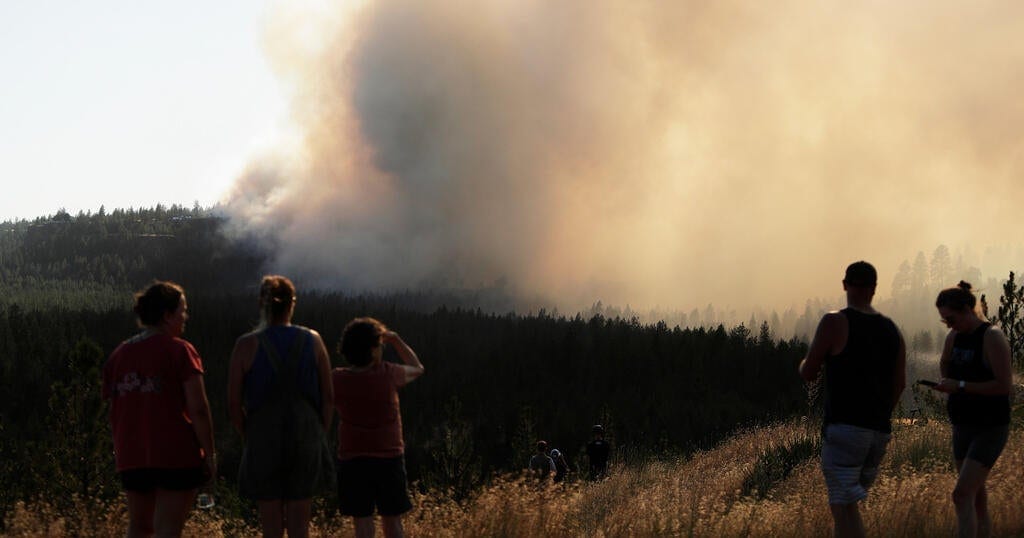
Fast-moving wildfires in Washington have destroyed hundreds of homes in the Spokane area, with officials describing it as the worst natural disaster the region has faced, according to CBS News reporting on Sunday. Three separate blazes, named the Old Trails Fire, the Fairview Fire and the Autumn Lane Fire, are burning near Spokane as crews race to protect communities and critical infrastructure.
The report, published August 2, 2026, underscores how quickly the situation escalated, with all three fires moving rapidly and converging on populated areas. With damage already described in the hundreds of homes and the threat still active, the fires have become one of the most urgent emergencies in the Pacific Northwest this week.
Key facts
- Source
- CBS News
- Reported
- August 2, 2026
- Desk
- general
- Follow the story
- Spinn Radio Talk
Where the Washington wildfires are burning near Spokane
CBS News identifies three separate fires in the Spokane area: the Old Trails Fire, the Fairview Fire and the Autumn Lane Fire. All three are in or around communities tied closely to Spokane, which means they are not remote forest incidents but wildfires with direct urban and suburban impact.
The key takeaway is geographic concentration. Multiple fires clustered around one metropolitan region create a much more complex emergency than a single distant blaze. For anyone with friends or family in or near Spokane, the fire names Old Trails, Fairview and Autumn Lane are the ones to track in local alerts and live coverage as the situation shifts.
“Multiple fires clustered around Spokane turn a bad fire day into a regional crisis.”
Why officials call it the region's worst natural disaster
CBS News reports that local officials describe the current fire outbreak as the worst natural disaster the region has faced. That language signals that this is not just another difficult fire season but an event being measured against decades of floods, storms and past fires in the Spokane area.
The destruction of hundreds of homes is central to that assessment. A fire that jumps into neighborhoods does more than scorch land. It erases housing, displaces families and strains shelter systems and social services. Even without full numbers yet, the scale of housing loss already places this disaster in a different category for the region, and the phrase "worst natural disaster" will likely shape how recovery funds, state support and federal attention are argued for in the weeks ahead.
“When officials reach for the phrase "worst natural disaster, " they are already thinking in terms of long-term recovery, not just fire suppression.”
Spinn Radio
Follow live news on Spinn Radio
What we know so far about damage and evacuations
According to CBS News, hundreds of homes have been destroyed by the wildfires around Spokane. That is one of the clearest, most sobering data points so far, even as frontline reporting is still developing and many neighborhoods remain off-limits while fires are active.
A count in the hundreds suggests significant neighborhood-scale losses, rather than scattered, isolated structures. It also implies that evacuation orders or strong recommendations have either been issued or rapidly improvised as flames approached homes. While detailed maps of burn scars and evacuation zones have not yet been reported, the confirmed loss of so many homes tells residents everything they need to know about the seriousness of the threat.
For people trying to stay informed in real time, radio and live audio can be crucial when power or mobile networks are unstable. Coverage on Follow live news and talk on Spinn Radio will focus on updates from local officials, changing fire lines and resource information as authorities provide it.
“The phrase "hundreds of homes" is not just a statistic, it points to whole neighborhoods facing long-term displacement.”
How the Old Trails, Fairview and Autumn Lane fires became so dangerous
CBS News describes the current blazes as fast-moving, which is a critical detail for understanding why the fires became so destructive. When a fire advances quickly, emergency managers have less time to issue warnings, residents have less time to pack and leave, and fire crews have fewer opportunities to set up defensive lines around homes and key infrastructure.
Three named fires burning in the same general region also stretch resources. Crews and aircraft that might normally concentrate on a single incident have to split attention among Old Trails, Fairview and Autumn Lane. That fragmentation can leave some subdivisions and rural roads more exposed, especially if winds shift or new spot fires ignite ahead of the main fronts.
The speed and the number of concurrent fires are the essential takeaways. A slow-moving wildfire in unpopulated terrain can be monitored over days. Fast-moving fires in a populated region like Spokane can force life-or-death decisions in minutes, which is part of why officials are already using such stark language about the scale of the disaster.
“Speed turns a wildfire from a landscape event into a neighborhood emergency.”
What to watch next as Washington wildfire conditions evolve
The CBS News report from August 2 is a snapshot of an emergency that is still unfolding, not a post-mortem. Key unknowns remain: containment levels on the Old Trails, Fairview and Autumn Lane fires, updated counts of destroyed and damaged homes, the number of people displaced, and how weather over the next several days might either help or hinder firefighting efforts.
Another critical factor is how quickly state and federal support can mobilize once damage assessments become clearer. Local descriptions of the fires as the region's worst natural disaster will resonate as those agencies decide on disaster declarations, funding, and longer-term housing support for those who have lost homes.
For now, the most important step for residents is to monitor verified alerts and to prepare for changing conditions around Spokane. For listeners following from elsewhere, this fire complex is emerging as one of the defining environmental news stories out of Washington this summer, worth tracking through developing coverage and expert analysis on Spinn Radio Talk.
“This is a live emergency, not a finished chapter, and the final story of the Spokane fires will be written over the coming weeks and months.”
Good to know
Frequently asked questions
Where are the current Washington wildfires burning?
The current wildfires are burning in the Spokane area of Washington state. CBS News names the Old Trails, Fairview and Autumn Lane fires as the key incidents to watch.
How many homes have been lost in the Spokane wildfires?
CBS News reports that hundreds of homes have been destroyed by the wildfires near Spokane. That level of damage suggests entire neighborhoods have been heavily affected.
Why are officials calling this the region's worst natural disaster?
Officials are calling this the region's worst natural disaster because fast-moving fires have destroyed hundreds of homes around Spokane. The scale of housing loss and displacement sets it apart from previous local emergencies.
How can I follow live updates on the Spokane fires?
You can follow live updates on the Spokane fires through ongoing news coverage and radio. Spinn Radio is carrying breaking coverage and analysis on its Follow live news and talk on Spinn Radio channel.
Explore more on Spinn Radio: Follow live news and talk on Spinn Radio
Sources