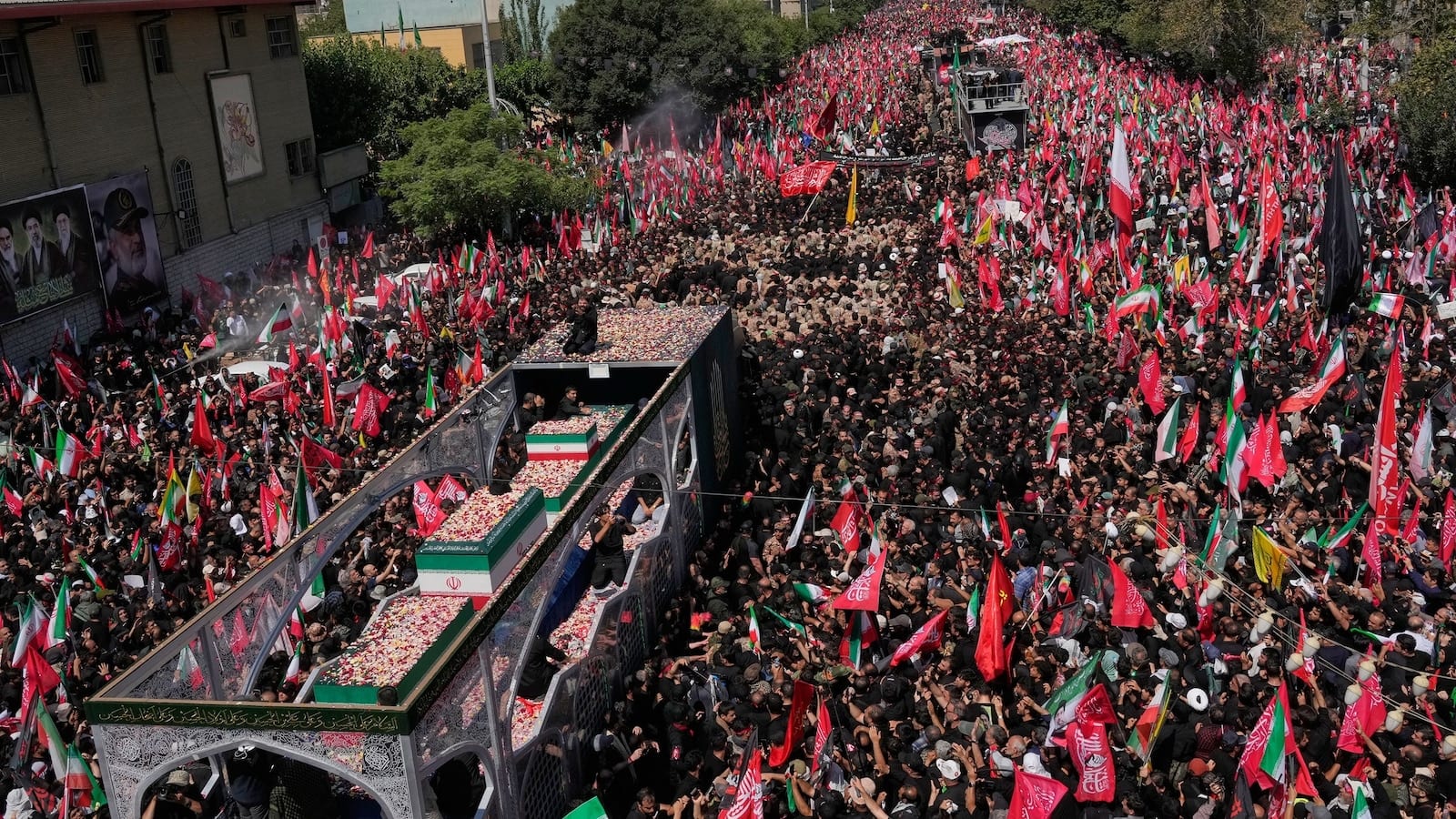
Massive crowds have filled the streets of Tehran for the funeral of Ayatollah Ali Khamenei, ABC News reported on July 6, 2026, in a development that collides directly with a sharp military escalation between Iran and the United States. The timing, coming just after President Donald Trump announced “major combat operations” against Iran with joint U.S., Israeli strikes, turns a day of mourning into a moment of geopolitical risk.
The ABC News report underscores how Iran’s leadership transition and the new phase of conflict are unfolding at the same time, with thousands in the capital signaling support, anger, grief or a mix of all three. What happens in these streets, and how Tehran’s rulers respond while missiles are flying, will shape the next phase of a confrontation that is suddenly back at the center of global attention.
Key facts
- Source
- ABC News - Breaking News, Latest News and Videos
- Reported
- July 6, 2026
- Desk
- general
- Follow the story
- Spinn Radio Talk
What ABC News is reporting from Tehran right now
ABC News, in a headline published on July 6, 2026, says thousands have thronged the streets of Tehran for Khamenei’s funeral. It places the story as unfolding in real time, with crowds converging in the Iranian capital while the country absorbs both the loss of its long‑time supreme leader and a surge in external military pressure.
This image of packed streets matters because it is one of the first public gauges of sentiment inside Iran after the announcement of “major combat operations” against the country. Crowds of that scale can signal support for the political system, defiance toward foreign powers, or deep anxiety about what comes next. For outside observers, the turnout is a reminder that despite years of sanctions and internal unrest, millions of Iranians still respond when the state calls a national moment of mourning.
The key takeaway so far: Tehran is not quiet or cowed. It is out in the open, in large numbers, at the same time U.S. and Israeli forces are hitting targets that President Trump folded into his description of a new combat phase.
“Tehran is not quiet or cowed; it is out in the open, in large numbers, while a new combat phase has just been announced.”
How Trump’s ‘major combat operations’ changed the stakes
The current funeral crowds are unfolding in the shadow of President Trump’s February 28 announcement of “major combat operations” against Iran, which included massive joint U.S., Israeli strikes. That line from the president marked a shift from pressure and deterrence into something closer to an open campaign, at least in his own words.
Joint action with Israel is especially significant because it aligns two long‑time adversaries of Tehran more tightly in the eyes of Iran’s leadership and public. For many in those funeral processions, the foreign threat is not abstract. It is tied concretely to the president’s description of a new phase of combat and to visible military activity in the region.
The takeaway: this is not a routine state funeral. It is happening while Iran’s adversaries say they are in the midst of a large, coordinated military effort, which raises the risk that any gesture from Tehran, symbolic or military, will be interpreted through the lens of escalation.
Spinn Radio
Follow live news on Spinn Radio
Why Khamenei’s funeral crowds matter for Iran’s future
A funeral for a figure of Khamenei’s stature is always political. The sheer size of the crowds that ABC News says have filled Tehran adds another layer: it offers a first snapshot of how Iranians are responding to a power vacuum at the very top while their country is under external attack.
The turnout can influence who feels emboldened in the succession struggle, from hard‑line loyalists to any rivals waiting in the wings. It can also shape how confident the security establishment feels about mobilizing people for future confrontations, whether against protesters at home or foreign forces abroad.
For anyone trying to read the next chapter, one crucial detail to remember is that these crowds appeared after fresh U.S., Israeli strikes were publicly acknowledged by the American president. That means every chant, banner, or procession is taking place with that escalation already baked into the crowd’s mood.
Regional and global reactions to the Tehran scenes
Images of dense processions in Tehran will be watched closely in regional capitals that have lived with, and sometimes benefited from, the Iran, U.S. rivalry. For allies of Washington, the question will be whether the funeral becomes a platform for fiery rhetoric that could justify further action by Iranian proxies. For partners of Tehran, the crowds can be framed as proof of resilience in the face of U.S. and Israeli strikes.
Globally, governments will read the ABC News reporting on both the funeral and the stepped‑up military campaign as a signal that the risk of miscalculation is rising. A large, emotionally charged crowd at a moment of national grief and anger is exactly the kind of backdrop that can make moderation harder for political elites, especially when they feel under siege.
The immediate takeaway for outside audiences is simple: Iran’s domestic pageantry and the external confrontation are no longer separate stories. What happens in those Tehran streets is now part of the security calculation for every state that has a stake in the Gulf, from energy importers to military partners.
What to watch next in Iran after the funeral
With ABC News highlighting both the Tehran crowds and the new phase of combat operations, the next key questions center on how Iran’s leadership responds once the formal ceremonies end. Analysts will be watching for any public statements framed around the funeral that reference the U.S., Israeli strikes, as well as any shift in the tempo of military activity attributed to Iran or its allies.
Another crucial angle is whether the massive turnout translates into tighter control by Iran’s power brokers or exposes tensions that had been contained while Khamenei lived. The funeral could either consolidate a hard line in dealing with Washington, or, over time, feed calls for a recalibration if the costs of confrontation mount.
For ongoing context, coverage, and live reaction to how this high‑risk moment unfolds, listeners can Follow live news and talk on Spinn Radio. As more details emerge from Tehran and from battlefields touched by those joint strikes, the relationship between crowds on the streets and decisions in war rooms will be the story to watch.
“The relationship between crowds on the streets and decisions in war rooms will be the story to watch.”
Good to know
Frequently asked questions
What is happening in Tehran right now?
Tehran is seeing massive funeral crowds for Ayatollah Ali Khamenei, according to ABC News. The processions come as Iran faces new U.S., Israeli strikes.
How did Trump escalate the conflict with Iran?
President Donald Trump announced “major combat operations” against Iran on Feb. 28 that included massive joint U.S., Israeli strikes. That declaration marked a shift to a more open phase of confrontation in his own framing.
Why do the funeral crowds in Iran matter politically?
The funeral crowds matter because they show public mobilization during a leadership transition under fire. That turnout can shape who feels empowered in Iran’s power struggle.
What should observers watch for after the funeral?
Observers should watch how Iran’s leaders frame the funeral in statements about the U.S., Israeli strikes. Any change in military tempo or political rhetoric will signal the next phase of the standoff.
Explore more on Spinn Radio: Follow live news and talk on Spinn Radio