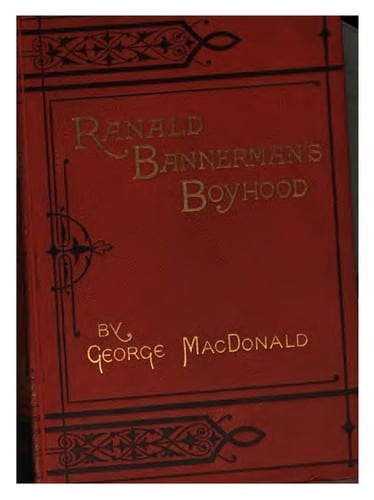
Ranald Bannerman's Boyhood might be shelved as children's fiction, but it lands in the ear like a remembered childhood, full of scrapes, storms and small moral victories. In audio, George MacDonald's somewhat autobiographical tale of a motherless boy in a Scottish manse feels unusually intimate, as if the storyteller has settled in your living room for the evening.
Known now for fantasy like At the Back of the North Wind and The Princess and the Goblin, MacDonald built his career on far more realistic novels. This one, first published in 1871 and praised by The New York Independent as "full of sweetness, full of boy-life and true goodness", shows why his contemporaries trusted him not only with their dreams, but with their day-to-day hearts.
Key facts
- Author
- George MacDonald
- Genre
- Children's Fiction
- Published
- 1871
- Language
- English
- Chapters
- 36
What Ranald Bannerman's Boyhood is actually about
Ranald Bannerman's Boyhood follows a young, motherless boy growing up with his brothers in a Scottish manse, watched over by a thoughtful, principled father. Across 36 chapters, the story tracks Ranald's escapades and misjudgments, the friendships he forges, and the lessons he absorbs almost despite himself. It is children's fiction, but rooted in recognisable family dynamics rather than outright fantasy.
MacDonald populates Ranald's world with memorable figures that lodge in the imagination. There is Kirsty, the Highland storyteller whose tales shape how the boys see courage and danger. There is Turkey, the intrepid cowherd, always a little closer to the edge of risk than Ranald expects. Then come darker shapes: the "evil Kelpie" that looms in local lore and fear, and the lovely Elsie Duff, whose presence nudges Ranald's sense of loyalty and integrity. Every minor adventure carries a quiet test of character.
The premise is simple enough to summarise: a boy in a manse learns what courage and goodness mean in practice. The pleasure of listening lies in the detail of his misadventures and in how his father uses each one to teach him something about honesty, responsibility and self-respect. If you remember the feeling of wanting to do right but not quite knowing how, the emotional terrain here will be instantly familiar.
“The premise is simple: a boy in a manse learns what courage and goodness mean in practice.”
George MacDonald beyond the fairy tales
George MacDonald is usually introduced as a master of fantasy, the author of At the Back of the North Wind and The Princess and the Goblin, a writer whose influence on later fantasy is endlessly cited. Ranald Bannerman's Boyhood reminds us that, in his own lifetime, readers knew him just as much for realistic fiction. This book sits among those quieter, less spectacular novels where he trades goblins and personified winds for farms, manses and flesh-and-blood families.
The story is described as "somewhat autobiographical", and that phrase matters. MacDonald grew up in Scotland, and you can hear that lived familiarity in the way he writes the manse and the surrounding countryside, the rhythms of speech in characters like Kirsty, and the moral weight he gives to a father's instruction. Published in 1871, the novel belongs to a moment when children's fiction was increasingly willing to deal with loss, doubt and temptation, provided the author guided young readers toward "true goodness".
When The New York Independent praised the book in 1871 as "full of sweetness, full of boy-life and true goodness", it captured exactly what still registers now. MacDonald does not sentimentalise Ranald's grief at being motherless, or the fear stirred by stories of the Kelpie. Instead he uses those feelings as the ground on which his characters grow. Listening today, you are not just hearing a Victorian curiosity, you are dropping into the emotional weather of a boyhood that feels surprisingly modern in its questions.
“MacDonald trades goblins and personified winds for farms, manses and flesh-and-blood families.”
Spinn Radio
Listen to Ranald Bannerman's Boyhood on Spinn Radio
Themes that make Ranald Bannerman's Boyhood still worth hearing
The core themes of Ranald Bannerman's Boyhood are old-fashioned in the best sense. Courage here is not battlefield heroism but the willingness to admit a lie, face a frightened sibling, or walk toward rather than away from a frightening story like the Kelpie. Integrity, likewise, is less about dramatic self-sacrifice and more about the small, stubborn choice to do the right thing when no one is watching.
Because Ranald is motherless, the relationship with his father carries extra charge. Across the 36 chapters, the manse becomes a kind of moral classroom, each episode an occasion for the father to show rather than lecture about trust, forgiveness and responsibility. Kirsty's tales, Turkey's daring, and Elsie Duff's presence all test and shape Ranald's sense of self. The result is a portrait of boyhood where imagination and ethics are inseparable.
For a contemporary listener, one memorable takeaway is how seriously the book takes children's inner lives. It treats "boy-life" as worthy of close attention, from petty jealousies to conscience-pricking regrets. That is part of why it endures: it validates the intensity of childhood feeling instead of talking down to it. If you are listening with a child, you will find plenty of natural pause points where a scrape or a moral choice invites conversation.
“Courage here is not battlefield heroism but the quiet decision to do right when no one is watching.”
What the audiobook experience of Ranald Bannerman's Boyhood feels like
In audio, Ranald Bannerman's Boyhood plays to its strengths as a story built around voices. Kirsty is described as an enchanting Highland storyteller, and much of the book effectively imitates that kind of fireside narration. The rhythms of her tales about the Kelpie sit alongside the father's more measured explanations, creating a layered soundscape of story within story when read aloud.
Because the novel is divided into 36 chapters, it lends itself naturally to episodic listening. Each chapter contains a reasonably self-contained incident or lesson, which makes it easy to share over several evenings or to dip into on commutes. The structure encourages a listening pattern that mirrors the way Victorian families might have first encountered it: chapter by chapter, with time for the story to settle in between.
Knowing that the book is children's fiction written in English in 1871 also helps set expectations for tone. The language carries a period flavor and a moral earnestness that suit a calm, attentive listen rather than a background soundtrack. If you are exploring George MacDonald through audio, this is a strong candidate to sit alongside his more famous fantasies, because it reveals how he shapes character and atmosphere without relying on the supernatural.
“In audio, it feels like what it describes: a boyhood shaped by stories told aloud in the glow of the hearth.”
Where Ranald Bannerman's Boyhood sits in children's fiction today
Ranald Bannerman's Boyhood belongs squarely to children's fiction, but it does not fit neatly into the darker, more ironic trend of many contemporary books for young readers. Its stakes are local and moral rather than apocalyptic. That difference can be refreshing. You spend time in a Scottish manse with brothers, a father, a cowherd and a storyteller, and the drama feels human-scaled.
As an example of 19th-century children's fiction in English, the book is also useful for anyone interested in how the genre developed. Its publication year, 1871, puts it in conversation with other Victorian attempts to write seriously about childhood without stripping away its playfulness. The praise it received on release signals that readers then recognised something honest in its depiction of "boy-life".
For listeners today, the enduring value lies in how clearly the story invites empathy. You are meant to care about Kirsty's tales, to worry for Turkey when his daring goes too far, to notice how Elsie Duff changes the emotional temperature of a scene. That attention to small shifts in feeling is what makes this more than a period piece. It is a gentle reminder that courage and integrity are learned in moments that, at the time, seem almost ordinary.
Good to know
Frequently asked questions
Who wrote Ranald Bannerman's Boyhood?
Ranald Bannerman's Boyhood was written by George MacDonald. He is also known for children's fantasy works such as At the Back of the North Wind and The Princess and the Goblin.
What genre is Ranald Bannerman's Boyhood?
Ranald Bannerman's Boyhood is a work of children's fiction. It focuses on realistic boyhood adventures and moral lessons rather than MacDonald's more famous fantasy worlds.
When was Ranald Bannerman's Boyhood published?
Ranald Bannerman's Boyhood was published in 1871. Contemporary reviewers like The New York Independent praised it for its "boy-life" and "true goodness."
How many chapters are in Ranald Bannerman's Boyhood?
Ranald Bannerman's Boyhood contains 36 chapters. The structure makes it ideal for episodic listening, one chapter at a time as an audiobook.
What language is Ranald Bannerman's Boyhood in?
Ranald Bannerman's Boyhood is written in English. Its 19th-century style has a gentle, period feel that suits being read aloud.
Sources